Ōzan Kofun Cluster, Kofun cluster in Sabae, Fukui Prefecture, Japan
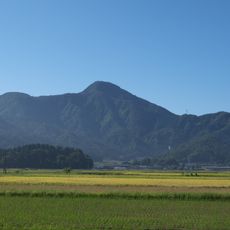
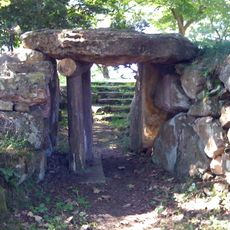
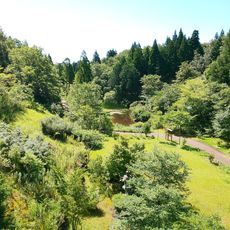
The Ōzan Kofun Cluster is a group of 49 tumuli on Ōzan, a 62-meter isolated hill in the Hinode area of Sabae, Fukui Prefecture. The mounds date from the late Yayoi period (3rd century) to the mid-Kofun period (5th century) and include square and round tombs, now linked by walking trails in a public park.
The 49 tumuli on Ōzan hill were built from the late Yayoi period (3rd century) to the mid-Kofun period (5th century). Eleven were excavated in 1965, including square Yayoi mounds and early Kofun round tombs. The hill was first protected in 1942; after a 1967 survey revised the boundaries, the site was designated a National Historic Site that same year.
The name Ōzan refers to the hill itself, and the 49 tumuli were raised by local chieftains between the late Yayoi period and the early Kofun period. Pottery from the Tōkai and Ōmi regions found in tomb No. 3 shows ties with communities far to the east and west. The hill is now a public park with walking trails threading between the mounds.
The site lies on a wooded hill about 66 metres high at the southern edge of the Sabae plateau, roughly a five-minute walk from Sabae Station on the JR West Hokuriku Main Line. Walking trails run between the mounds through the maintained kofun park.
Tomb No. 31, a round mound 20 metres across and 2 metres high, held two split-bamboo wooden coffins; the first yielded an iron sword, arrowheads, a sickle and a hoe, the second a bead. Tomb No. 32, about 8 metres wide, contained an iron sword, arrowheads, a small knife and a spear-shaped plane.
The community of curious travelers
AroundUs brings together thousands of curated places, local tips, and hidden gems, enriched daily by 94,797 contributors worldwide.