Itoshiro Cedar, Giant tree in Gujō, Japan.
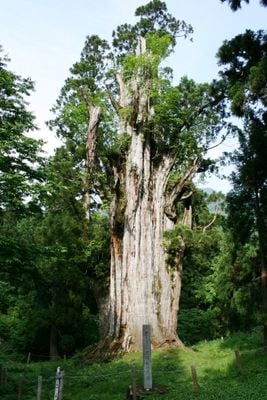
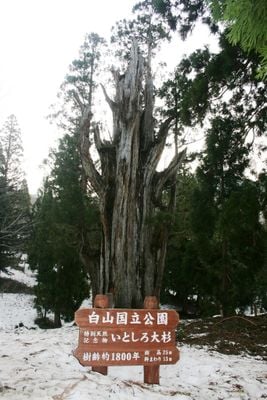
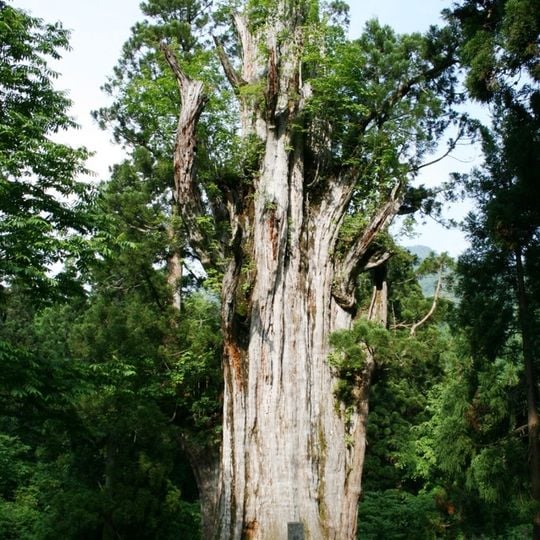
Itoshiro Cedar is a Japanese cedar (Cryptomeria japonica) in Gujō, Gifu Prefecture, within Hakusan National Park. The tree stands 24 m tall with a trunk circumference of 14 m; its lower half is a thick, largely unbranched column that splits into several vertical limbs above, and about half the trunk is dead while the other half still bears pale green foliage. A wooden sign at the base reads "白山国立公園".
Tradition holds that the walking staff of the monk Taichō, who opened Mount Hakusan to worship, took root and became this cedar. It was designated a national Natural Monument on 9 December 1924 as the "Itoshiro Cedar" and a Special Natural Monument on 2 July 1957. The Itoshiro district belonged to Fukui Prefecture's Ōno District until 15 October 1958, when it was transferred to Shirotori in Gifu.
The tree stands along the Mino Zenjōdō pilgrimage route of Hakusan worship and also served as a waymarker for travellers. Legend says the staff of the monk Taichō, who opened Mount Hakusan, grew into this cedar. A spring called Kumashimizu lies just north of the trunk, and beech forest surrounds the site.
Visitors can reach the tree by following marked forest paths, with designated viewing areas offering close views of the trunk and overall structure. Sturdy footwear is recommended, and weather conditions may affect path conditions at different times of year.
The tree stands on the old Mino Zenjōdō pilgrimage route of the Hakusan faith and long served as a trail marker for pilgrims. Legend says the staff of the monk Taichō, who opened Mount Hakusan, took root and became this cedar. Until the Jōmon Sugi on Yakushima was discovered, it ranked among Japan's largest cedars.
The community of curious travelers
AroundUs brings together thousands of curated places, local tips, and hidden gems, enriched daily by 94,785 contributors worldwide.