Kamuikotan, Sacred canyon in Asahikawa, Japan.
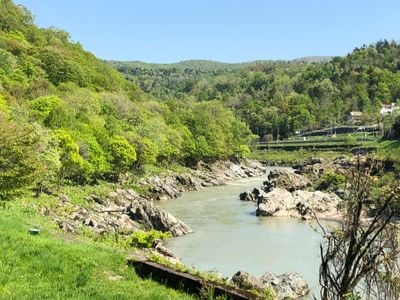
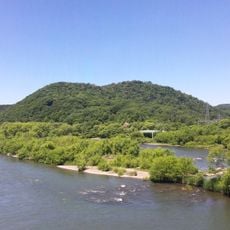
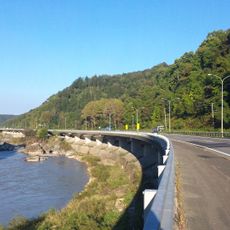
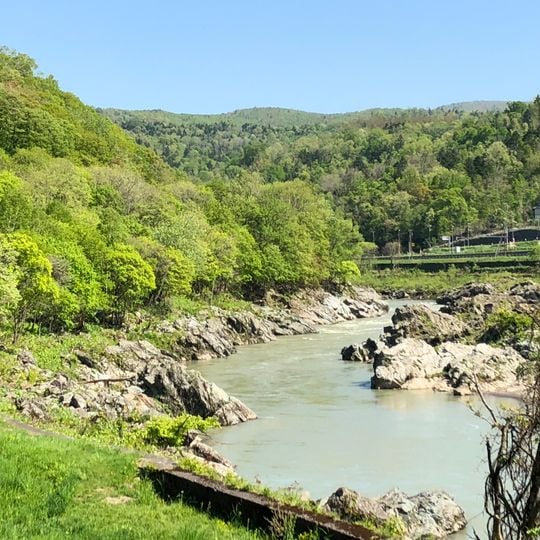
Kamuikotan is a gorge on the Ishikari River in Asahikawa where the river leaves the Kamikawa Basin and narrows into a fast, thin current said to reach 70 m deep. Both banks are lined with large light-gray boulders and jagged rock ledges, with grass and low vegetation between the rocks and forested slopes rising beyond. The riverbed holds potholes scoured by pebbles, and the valley gives its name to the Kamuikotan metamorphic belt, chosen as one of Japan's 100 geological sites in 2007.
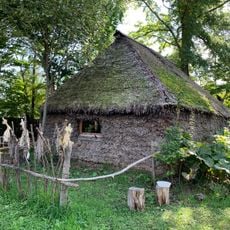
The area holds the Kamuikotan pit-dwelling site, a Hokkaido-designated historic site, plus stone circles showing settlement since the Jomon period. In 1898 the Hakodate Main Line opened along the river's north bank; Kamuikotan Station followed in 1901, and the first bridge, Makihashi, was built to the opposite settlement. The line was rerouted through the Kami Tunnel in 1969, closing the station; the old track is now a cycling road.
The name Kamuikotan derives from the Ainu phrase kamuy kotan, meaning 'place where the gods dwell', a rendering of the river's danger: the Ishikari's narrow, fast current here was the hardest passage for the Ainu, who often lost people and prayed for safe crossing. A yukar epic tells that the evil god Nitnekamui threw boulders into the river to drown travellers; the mountain god Nupurikamui and the hero Samaykuru fought him, and the potholes in the riverbed are said to be the footprints where he sank into the mud.
Buses of Dohoku Bus, Engan Bus (Rumoi–Asahikawa line) and Sorachi Chuo Bus (Shin–Asahikawa line) stop at Kamuikotan. By car, enter from just before the National Route 12 Kamuikotan Tunnel; the road is one-way from the Fukagawa side toward Asahikawa, so on the way back rejoin the main road near Muden Kannon. A cycling road runs along the former railway, though the disused section has sometimes closed after rockfalls.
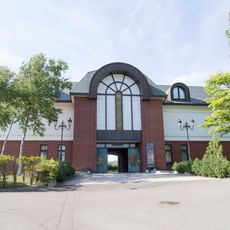
The site displays three preserved steam locomotives and a reconstructed station building that recall the historical railway once running through here. These remnants show how important train travel was to the region in the past.
The community of curious travelers
AroundUs brings together thousands of curated places, local tips, and hidden gems, enriched daily by 93,643 contributors worldwide.