Shinmei-sha, Shinto shrine in Japan
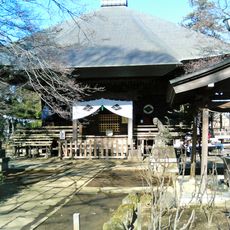
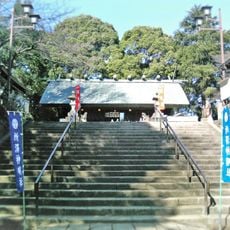
Shinmei-sha is a small shrine in the Nakatomi district, built in the traditional Shinmei-zukuri style with simple wooden lines and natural materials. The building stands on a raised platform with clean, straight forms and no elaborate carvings, featuring a roof covered with wooden shingles.
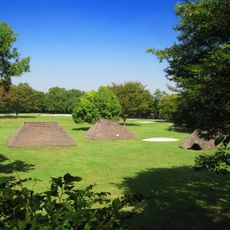
In 1696 Yanagisawa Yoshiyasu, then lord of Kawagoe, opened the villages of Kamitomi, Nakatomi and Shimotomi as the Santomi shinden. Under the one-temple-one-shrine rule he founded Bishamondo and Tamonin in Nakatomi as the settlers' tutelary shrine. Seven neighbouring shrines were formally invited and merged in 1907 and 1912, and the 1869 separation of Shinto and Buddhism split the precinct, the shrine on the west and Tamonin on the east. In March 1928 the Santomi settlement site was designated a historic site by Saitama Prefecture.
Locals call it "Tome no Shinmei-sama". The shrine honours six deities, including Amaterasu and Toyouke, and its grounds hold a Tenjin-sha and an Imo-jinja dedicated to sweet-potato promoters Yoshida Yaemon and Aoki Konyo. On 1 January the Ue-Tomi Hayashi Preservation Society performs a lion dance at the New Year rite.
The shrine stands in Nakatomi, Tokorozawa, Saitama Prefecture. Its grounds adjoin those of Tamon-in, and the hedge between the shrine and the temple is still low, so visitors walk from one to the other without a barrier. New Year visits on 1 January bring crowds for the lion dance performed by the Kami-Tomi hayashi preservation group.
The shrine grounds were once shared with the neighbouring Bishamondo of Tamon-in, and the hedge between the two halves is still low. At Hatsumode, visitors walk through the subsidiary shrines and then pray at both the Shinto shrine and the Buddhist temple in one continuous round.
The community of curious travelers
AroundUs brings together thousands of curated places, local tips, and hidden gems, enriched daily by 94,901 contributors worldwide.