第三大川橋梁, Railway bridge in Shimogo, Japan
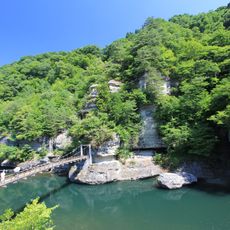
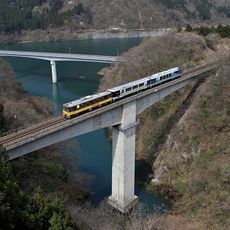
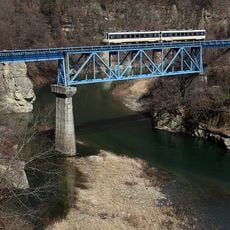
The Daisan-Ogawa Bridge is a railway bridge in Shimogo that crosses a deep valley with rocky terrain, linking two sections of the Aizu Railway Line. It features a steel structure designed to span the gorge while supporting regular train traffic through the mountainous Fukushima landscape.
Completed in 1932 as the Aizu Line was extended between Kamimiyori (now Ashinomaki-Onsen) and Yuno (now Yunokami-Onsen) stations, the first bridge carried a single-track deck Warren truss and four deck plate girders over the Aga River. In 1980 it was replaced by a second bridge of the same configuration, built by Yokogawa Bridge Works, to allow for higher water levels from the Ouchi Dam. The replacement won the 1980 JSCE Tanaka Award.
The bridge's name, Daisan-Ogawa, means "third O-kawa bridge" and follows the numbering of Aizu Line crossings of the Aga River. The 1980 replacement reused the original piers, thickened with concrete and anchored with PC steel wire so they stay stable when the dam lake is full. The old alignment branched off on the Kuwanohara side and crossed the now-abandoned second O-kawa bridge at Mezamegafuchi.
The bridge spans the Aga River between Kuwabara Station (now Ashinomaki-Onsen-Minami) and Yunokami Station (now Yunokami-Onsen) on the Aizu Railway Line. It lies near National Routes 121 and 118 and Tsurunuma River; the old line branched off on the Kuwabara side and crossed the now-abandoned second Ogawa bridge at Mezamegafuchi.
The 1980 replacement was the first railway bridge in Japan built with unpainted weathering steel, whose dense, stable rust layer halts further corrosion. Test panels were placed nearby so researchers could study how the steel ages. The truss members have a 5% drainage slope and box-shaped diagonals so water cannot collect.
The community of curious travelers
AroundUs brings together thousands of curated places, local tips, and hidden gems, enriched daily by 95,296 contributors worldwide.