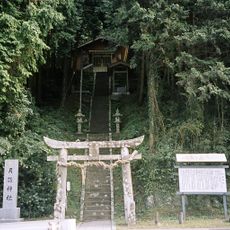
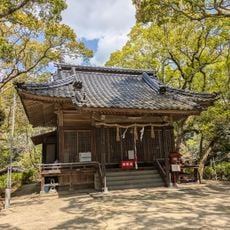
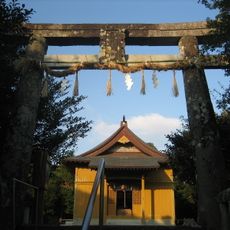
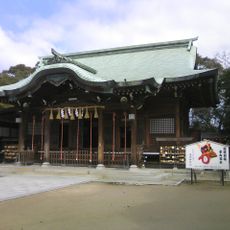
Kou-jinja, Shinto shrine in Ashibe, Iki, Japan
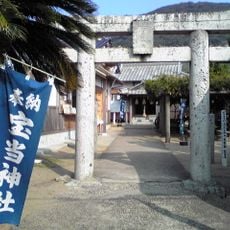
Kou-jinja is a Shinto shrine in the Yutake-Kō district of Ashibe, Iki, Nagasaki Prefecture. Its main hall is built in the nagare-zukuri style, and the grounds cover 997 tsubo (about 3,296 square metres). The shrine is one of the Iki Seven Shrines and is also known as Inyaku Daimyōjin, Kō-no-miya or Kokubu Shrine.
According to the Iki Koku Jinja-shi, Kou-jinja was founded on the first day of the tenth month of 812. In 856 the deity Tenochioo-no-kami was listed as an official shrine, and in 851 it received the junior sixth rank. Matsura Takanobu rebuilt the main hall in 1566 and the worship hall in 1568; Matsura Shigenobu rebuilt the main hall in 1645.
The shrine's name, Kō, is said to derive from kōfu, the provincial capital, and it was also called Inyaku Daimyōjin because it kept the keys and seal of the government storehouse. It is one of the seven shrines known as the Iki Shichisha, together with Sumiyoshi, Hongū Hachiman, Seibo-gū, Hakozaki Hachiman, Kunikatanushi and Shirasu Hachiman.
The shrine is easily accessible and offers the chance to receive a goshuin stamp as a souvenir, though it is best to call ahead since the priest's office hours can vary. Visitors are welcome to walk the grounds anytime to pray, stroll, and enjoy the quiet while respecting local traditions.
The shrine's name, Kō, is said to derive from kōfu, the provincial capital, and it also served as the keeper of the keys and seal of the provincial treasury, hence the name Inyaku Daimyōjin. The shrine is counted among the seven shrines of Iki, together with Sumiyoshi, Hongū Hachiman, Seibo-gū, Hakozaki Hachiman, Kunikatanushi and Shirasu Hachiman.
The community of curious travelers
AroundUs brings together thousands of curated places, local tips, and hidden gems, enriched daily by 93,782 contributors worldwide.