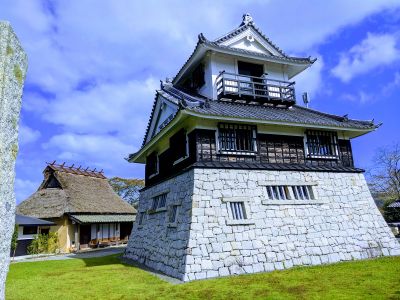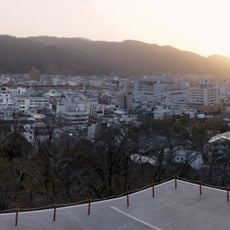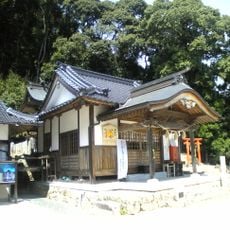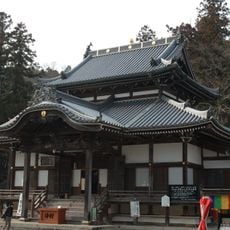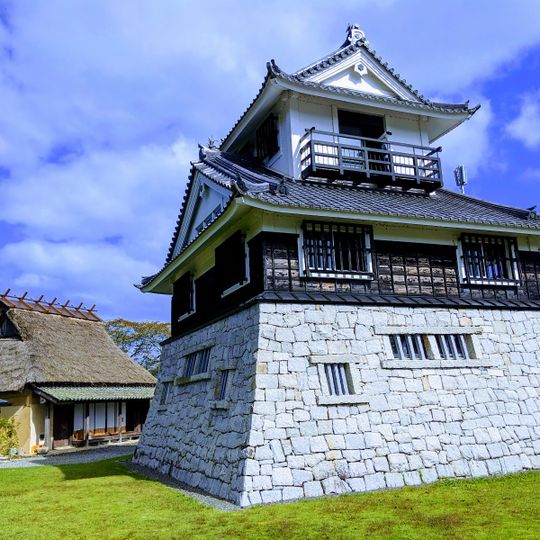
Château de Chausuyama, Historical Japanese castle ruins in Bizen Province, Japan.
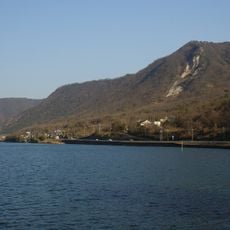
Chausuyama Castle is an earthwork mountain castle on Mount Chausuyama (about 180 m) in present-day Akaiwa, Okayama Prefecture, at the confluence of the Yoshii and Yoshino rivers. Its renkaku-style layout runs about 800 m along two ridges, with the honmaru an oval facing southeast, the ninomaru on the summit to its west, and traces of demaru, Taiko-maru, dry moats, a well, a small pond and earthen ramparts.
Chausuyama Castle was built in the early Tenbun era (1532–1555); its builder is unknown. It was an earthwork mountain castle of linked enclosures on two ridges, guarding the confluence of the Yoshii and Yoshino rivers and the upper reaches of Uragami Munekage's Tenjinyama Castle, 7 km downstream. It fell in 1579 when the Ukita clan invaded Mimasaka.
The site displays characteristic elements of Japanese castle architecture from the Sengoku period, with foundations and defensive structures still visible today. Visitors can understand how these fortifications functioned in medieval warfare strategies.
Multiple hiking trails lead to the castle site, with directional signs and viewing points placed along the paths for navigation. The climb requires moderate physical effort and sturdy footwear is recommended.
The castle has no stone walls: its defences are earthen embankments (dorui) and cut-out slopes along two ridges, running about 800 m in total. The keep area (honmaru) is a broad oval facing southeast, with the ninomaru on the summit just west of it.
The community of curious travelers
AroundUs brings together thousands of curated places, local tips, and hidden gems, enriched daily by 94,261 contributors worldwide.