Susa Shrine, Shinto shrine in Japan
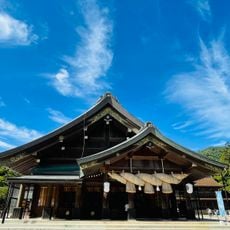
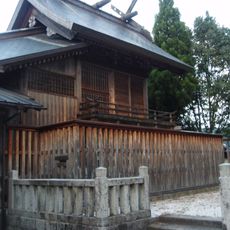
Susa Shrine is a Shinto shrine in Izumo, Shimane, whose honden was built in 1861 in the taisha-zukuri style: about 4 m square and roughly 12 m tall, with the entrance stair on the right-hand bay. The photograph shows a steep thatched roof edged with an orange and brown band, crossed beams projecting in an X at the ridge, and an upper veranda with a plain wooden railing above dark lattice panels.
The Izumo Fudoki records that Susanoo-no-Mikoto named this land Susa and enshrined his spirit here; the shrine appears as Susa-sha in that text and in the Engishiki. The English Wikipedia gives a founding date of 776. The honden was rebuilt in 1861 (Bunkyū 1), replacing an earlier building shown as four bays square in a 1320 Ōmiya-kozu map. In 1871 it took its present name, and in 1900 it was ranked a kokuhei-shōsha.
The name Susa comes from Susanoo's own words in the Izumo Fudoki: he called the land a good country and gave it his name. The shrine keeps a saltwater well he is said to have drawn from to purify the site; at high tide on the Sea of Japan, salt flowers appear on the ground beside it. On 15 August, dancers in a circle chant "Namu Amida" during the Nenbutsu Odori, a dance shaped by medieval Buddhist ascetics.
The shrine stands about 3 km on foot from the Susa bus stop, served by the Ichibata bus bound for Izumo Susa from Izumo-shi Station. A car park for around a dozen vehicles sits beside the grounds. The main sanctuary, a taisha-zukuri building of 1861, is reached by steps at its right-hand bay.
Susa Shrine claims seven wonders on its grounds, among them a cherry tree said to cast no shadow and a saltwater well where, at high tide on the Sea of Japan, salt flowers are said to rise from the ground. Analysis found the water to be a weak alkaline sodium sulfate-bearing saline spring.
The community of curious travelers
AroundUs brings together thousands of curated places, local tips, and hidden gems, enriched daily by 93,676 contributors worldwide.