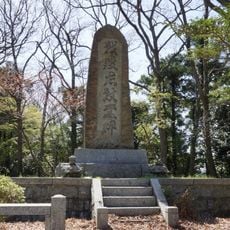
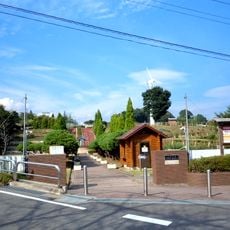
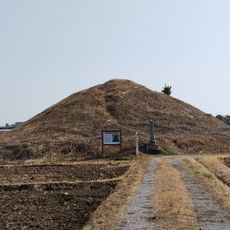
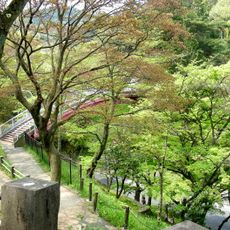
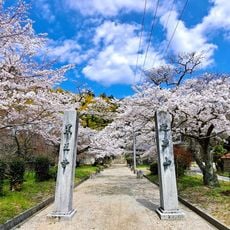
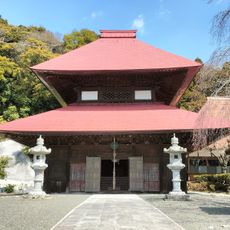
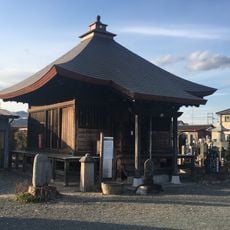
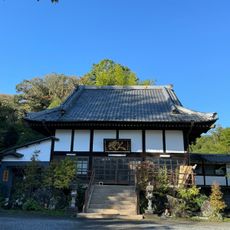
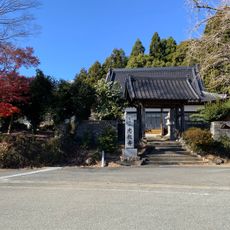
Iino Hachimangū, Ancient Shinto shrine in Iwaki, Japan.
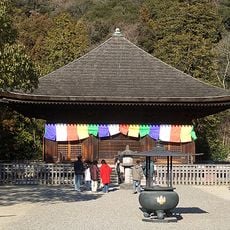
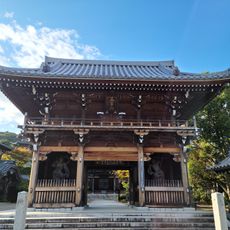
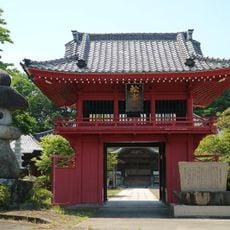
Iino Hachimangū is a Hachiman shrine in Taira, Iwaki, Fukushima Prefecture. Its main hall (honden) was built in 1616: a three-bay-by-three-bay irimoya-zukuri building with a hipped-and-gabled roof, originally nagare-zukuri but rebuilt with the irimoya roof in repairs of 1674 and 1703, and covered in shingles (kawara-buki). The grounds also hold a two-storey rōmon gate of 1658 and a copper-clad karamon gate from around 1696.
According to shrine tradition, Minamoto no Yoriyoshi founded it in 1063 after the Former Nine Years' War, enshrining a division of Kyoto's Iwashimizu Hachimangū. In 1186 Minamoto no Yoritomo had the main image brought from Iwashimizu to Akamezaki in Iino, making it the sōja of the Kōjima estate. After the Battle of Sekigahara the Iwaki clan was expelled; Torii Tadamasa moved the shrine in 1602 to its present Yahata-kōji site, where Iwaki-Taira Castle was then built.
The shrine enshrines Emperor Ōjin as Hondawake no mikoto, Empress Jingū as Okinagatarashihime no Mikoto, and Himegami, with a secondary shrine to Emperor Nintoku. Its annual festival falls on September 14. The name Iino comes from the former Iino village; the shrine was moved to its present Yahata-kōji site in 1602.
The shrine stands in Hachimankōji, a short walk from the Fukushima District Court Iwaki branch, north of Iwaki Station on the Jōban line. Its annual festival falls on 14 September. The grounds hold the main hall, a tower gate, a Chinese-style gate, a kagura hall and the Wakamiya Hachiman shrine.
The shrine keeps a naginata blade signed by Osafune Morikage and dated the 11th month of 1367, a Bizen smith's work held as an Important Cultural Property. Its archive, the Iino family documents, runs to 1,683 items. The main hall was built in 1616 and given its hip-and-gable roof in repairs of 1674 and 1703.
The community of curious travelers
AroundUs brings together thousands of curated places, local tips, and hidden gems, enriched daily by 95,331 contributors worldwide.