Holy Lavra of Saint Sabbas, Greek Orthodox monastery in the Kidron Valley, Palestine
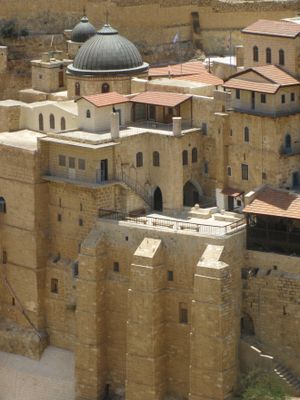
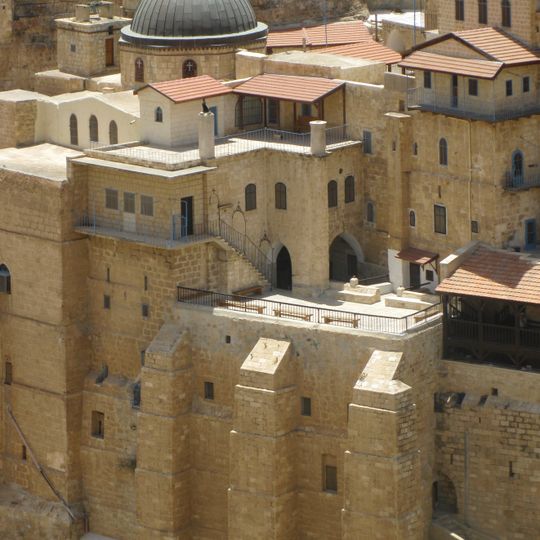
The Holy Lavra of Saint Sabbas is a Greek Orthodox monastery built against the cliff of the Kidron Valley, halfway between Bethlehem and the Dead Sea. Pale tan and beige masonry blocks form several flat-roofed levels stepping down the slope, with a round drum and dark dome at the top left, two pitched roofs of reddish-brown tile, and small arched and rectangular windows. A central terrace has a metal railing and a short flight of stone steps; two small domed pavilions stand on an upper terrace.
Sabbas the Sanctified founded the laura in 483 on the eastern side of the Kidron Valley; the community moved to the western side, where the Church of Theoktistos was built in 486 and consecrated in 491. The Church of the Theotokos followed in 502, and Sabbas's typikon became the model for the Byzantine Rite. An Arab attack in 797 killed twenty monks, and the monastery was later rebuilt and fortified. A Serbian community bought it in 1504 and held it until the late 1630s, when debts forced its sale to the Patriarch of Jerusalem.
The entrance shows old wooden beams and Byzantine symbols that recall centuries of prayer traditions. Monks live here under strict rules and speak Greek or Arabic while carrying out their daily duties.
Visitors should wear modest clothing and closed shoes as the terrain is uneven and respect for religious rules is required. Women can only view the complex from the outer tower, while men have access to the interior spaces.
A palm tree in the courtyard is said to have been planted by the founder himself and bears fruit without seeds. The mortal remains of the saint rest in a glass shrine inside the main church.
The community of curious travelers
AroundUs brings together thousands of curated places, local tips, and hidden gems, enriched daily by 93,156 contributors worldwide.