Hyrcania, Archaeological site in Bethlehem Governorate, Israel.
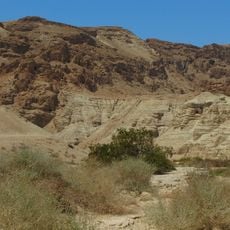
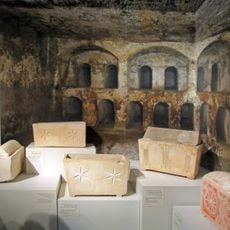
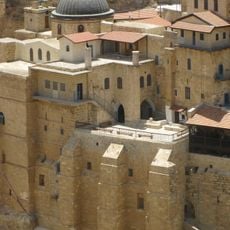
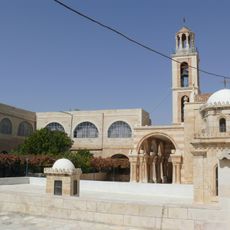
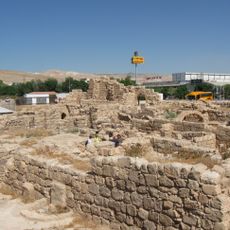
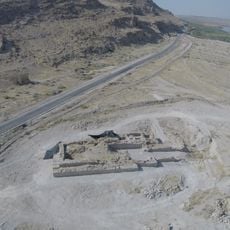
Hyrcania is a ruined fortress and monastery on an isolated hill rising about 200 metres above the Hyrcania valley, roughly 5 km west of Qumran and 16 km east of Jerusalem. The site preserves Hasmonean and Herodian fortification walls, a tower, and water cisterns, along with the remains of the Byzantine monastery of Kastellion, including a cave with faded wall paintings of named Christian saints.
The site began as a fortress, was later reinforced by Herod, and then held prisoners who opposed the ruler. It eventually transformed into a monastery that served religious purposes for centuries afterward.
The Arabic name Khirbet el-Mird and the Greek Kastellion both mean 'little castle', a name kept from the fortress. The monastery was a cenobium of hermits dependent on Mar Saba, 4 km to the south-west. A cache of 7th- and 8th-century monastic papyri found here in 1950 is now held in Leuven and the Rockefeller Museum.
Reaching the site requires effort, as it sits on remote terrain with a challenging walk to get there. Bring sturdy shoes and plenty of water, since shade is scarce and there are few facilities at the location.
Four rock-cut tunnels were found in a nearby wadi between 2000 and 2006. Two were cleared, yielding a Hasmonean clay pot, Hasmonean coins, and the skeleton of a young woman with sword cuts; they end abruptly at 80 and 120 metres.
The community of curious travelers
AroundUs brings together thousands of curated places, local tips, and hidden gems, enriched daily by 92,697 contributors worldwide.