Venda Nova Dam, Arch-gravity dam in Braga district, Portugal
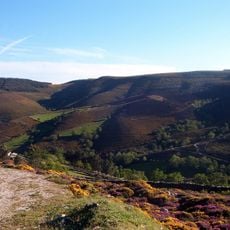
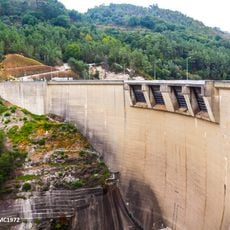
Venda Nova Dam is an embankment structure spanning across the Rabagão River in northern Portugal at an elevation of around 700 meters. The construction holds back a large body of water nestled within the mountainous terrain between multiple valleys.
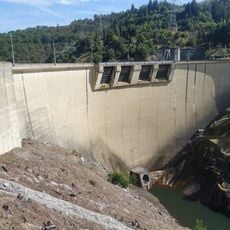
Work on the Venda Nova scheme began in 1948 and the dam was completed in 1951, built to generate electricity on the Rabagão. The concrete arch-gravity wall, 97 m high, was designed by André Coyne. A second plant, Venda Nova II, was added between 1997 and 2004, and Venda Nova III, Portugal's largest pumped-storage plant at 746 MW, entered service in July 2015.
The dam's reservoir is the upper basin of the Venda Nova II pumped-storage plant, which uses the Salamonde reservoir about three kilometres downstream as its lower basin. The plant's two reversible Francis pump-turbines, supplied by Voith Siemens Hydro, sit in a machine hall 350 m below the surface and were first used to generate power in August 2005.
The site is accessible via mountain roads, but weather at elevation can change quickly, so come prepared with appropriate gear. Best to visit from May through September when conditions tend to be most stable.
The dam is a concrete arch-gravity wall designed by French engineer André Coyne, 97 m high with a crest 230 to 294 m long. Its reservoir holds about 94.5 million m³, and the Venda Nova III pumped-storage plant added in 2015, Portugal's largest at 746 MW, uses two reversible turbines in a machine hall 350 m underground.
The community of curious travelers
AroundUs brings together thousands of curated places, local tips, and hidden gems, enriched daily by 93,120 contributors worldwide.