Radu Vodă Monastery, Orthodox monastery in central Bucharest, Romania
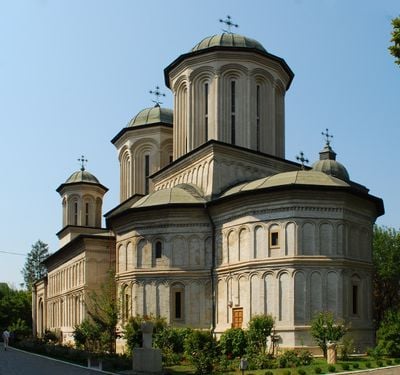
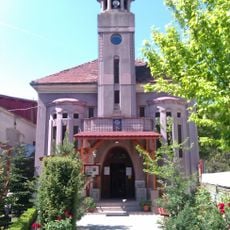
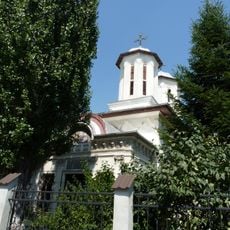
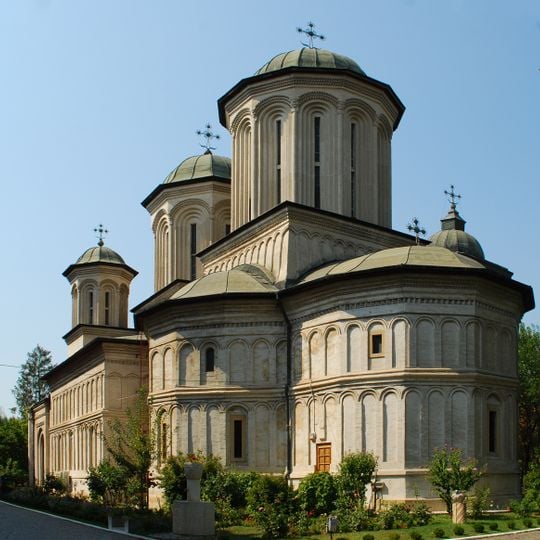
Radu Vodă Monastery is an Orthodox monastery in central Bucharest whose church is built of light grey stone blocks. A tall octagonal drum carries a wide flattened dome and cross, with two smaller domes behind and to the right and a square domed bell tower at the far left. The curved apse has rounded arches, narrow arched windows and a small wooden door, with a low green hedge along the base.
A first church on the hill is attributed to Mihnea cel Rău (1508–1509); the monastery was founded in 1577 by Alexandru II Mircea and his wife Catherine Salvaresso as a thanksgiving for victory in battle, intended as the capital's metropolitan church. It was completed under Radu Mihnea, whose name it bears, and in 1595 Sinan Pasha's troops used the church as a mosque before burning it. Radu Mihnea rebuilt it from the foundations in 1625 and dedicated it to Iviron Monastery on Mount Athos.
The monastery's name comes from Radu Mihnea, who completed it and gave it lands, villages and valuables; under him Bucharest's first library was set up here. In 1625 he dedicated the rebuilt monastery to Iviron Monastery on Mount Athos. The church holds the tomb of Patriarch Justinian Marina, who died in 1977.
The monastery is located on Radu Vodă Street in Sector 4 and is accessible to visitors daily, with regular services held throughout the week. It is best to explore the grounds respectfully, especially when religious services are taking place.
Archaeological excavations beneath the monastery have uncovered fortifications from the Getae-Dacian period. This reveals that the hill was a strategically important settlement long before the monastery was built.
The community of curious travelers
AroundUs brings together thousands of curated places, local tips, and hidden gems, enriched daily by 94,733 contributors worldwide.