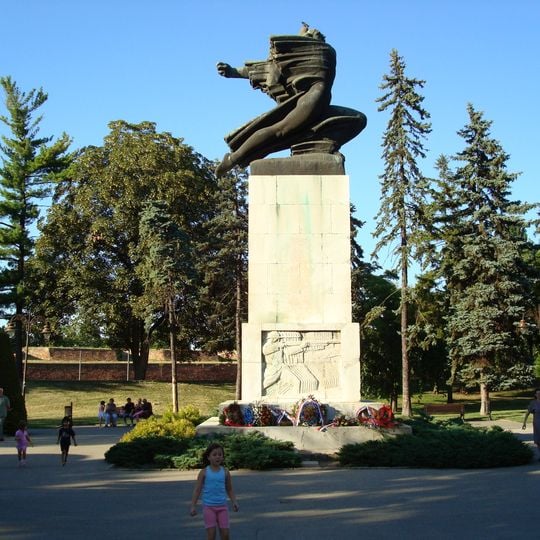
Monument of Gratitude to France, Historic monument in Kalemegdan Park, Belgrade, Serbia.
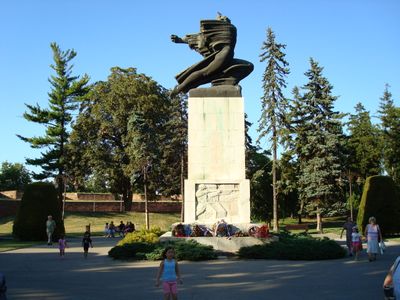
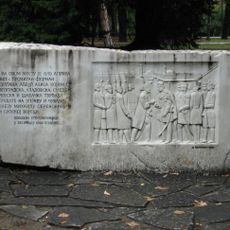
The Monument of Gratitude to France is a bronze female figure over four metres tall, holding a sword, set on a seven-metre pedestal of Brač marble. Cast in 14 pieces using the lost-wax technique, it stands at the end of the main avenue in Veliki Kalemegdan Park. Reliefs on the pedestal, carved by Meštrović's students, depict scenes of French aid.
The monument was unveiled on 11 November 1930, the twelfth anniversary of the end of the First World War, in the presence of King Alexander and Queen Maria. The initiative began in 1924 with a committee chaired by physician Niko Miljanić, after Belgrade's 1921 decision to honour French soldiers who died defending the city in 1915. It replaced the 1913 Karađorđe monument, destroyed by Austro-Hungarian forces in 1916.
The sculpture by Croatian artist Ivan Meštrović depicts a woman embodying France with a determined expression and raised fists as a gesture of strength. The work was crafted from 14 bronze pieces cast using lost-wax technique and placed on a marble base from Brač.
The monument stands at the end of the main park avenue in Veliki Kalemegdan, near Karađorđe's Gate, and the approach continues along Knez Mihailova Street. The front bears the year of erection and the dedication "A la France"; the rear reads "We love France as she loved us 1914-1918". The carved reliefs on the lower pedestal are at eye level on the sides.
The monument stands on the spot of the 1913 Karađorđe monument, blown up by Austro-Hungarian forces in 1916; the bronze of the replacement statue of Franz Joseph was later melted into church bells, the largest given to the Ružica church in Kalemegdan.
The community of curious travelers
AroundUs brings together thousands of curated places, local tips, and hidden gems, enriched daily by 93,672 contributors worldwide.