Kikin Hall, Petrine Baroque palace in Saint Petersburg, Russia
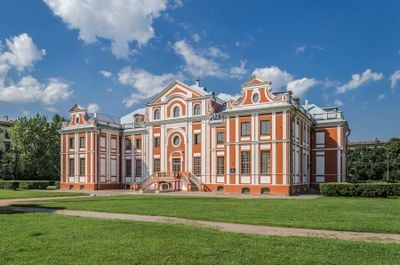
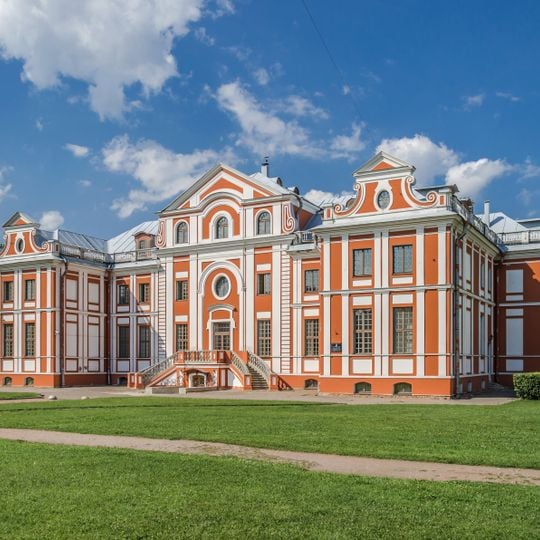
Kikin Hall is a Petrine Baroque palace at 9 Stavropolskaya Street, built in 1714 for Admiral Alexander Kikin. Its deep orange-red facade is outlined with broad white bands on pilasters, cornices and window surrounds, rising from a pale stone base. The central section projects slightly under a curved white-trimmed gable, with a large arched window above a doorway reached by a small double staircase; a taller pavilion with a rounded gable and oval window stands to the right, and a lower wing extends left. The roofs are grey metal.
The palace was built in 1714 for Alexander Kikin, a trusted advisor to Peter the Great, and confiscated in 1718 following Kikin's execution. The confiscation ended private ownership and began its use for public purposes.
From 1719 to 1727 the confiscated house held Peter I's personal library and the collection that became the Kunstkamera, later moved to its own building. The name Kikin Hall comes from Admiral Alexander Kikin, who had the residence built in 1714 and was executed in 1718 for arranging the escape of Tsarevich Alexei. Since the 1950s restoration the building has housed a music lyceum.
The building is located in the city center and now operates as a music school, so visitors should respect school hours when planning a visit. It is easily accessible on foot and sits on a street with other historic structures from the same period.
The palace's plan, outer form and linear dimensions match the central part of the Great Peterhof Palace, which is why the unknown architect is often linked to Andreas Schlüter. A tile sample found during the 1950s study helped restorers recreate the original roof covering.
The community of curious travelers
AroundUs brings together thousands of curated places, local tips, and hidden gems, enriched daily by 94,069 contributors worldwide.