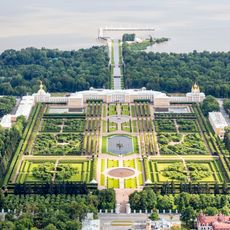
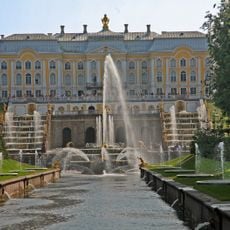
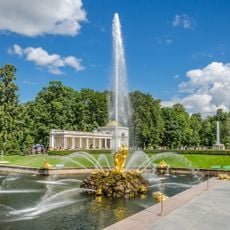
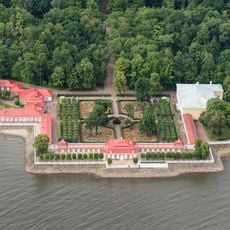
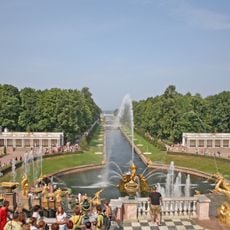
Chess mountain Cascade, Baroque fountain in Lower Gardens of Petergof, Russia.
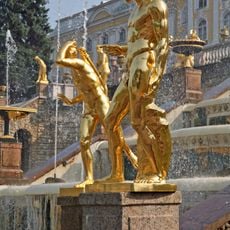
Chess Mountain Cascade stands on a natural slope in the Lower Park of Peterhof. It consists of two stepped brick walls faced with tufa, linked by beams that carry four sloping water boards. Single-arch grottoes sit at the top and bottom, three bronze dragons stand beside the upper grotto, and staircases flanked by ten marble statues on pedestals run along the sides.
Peter the Great ordered construction of this cascade in the early 1700s as part of his grand palace vision. The project emerged from his desire to demonstrate Russian artistic power through architecture inspired by European models.
The cascade displays bronze dragons and marble figures of ancient gods throughout its structure. Visitors can observe how European artistic traditions were adapted and interpreted through a Russian perspective.
The cascade stands on the natural slope of the Lower Park, with staircases on both sides leading past ten marble statues on pedestals. Water is supplied by a canal from the Upper Garden built by V. G. Tuvolkov, and the sluices were first opened in 1732. The dragons were recast in 1953 by A. Gurzhy after 18th-century drawings.
The water comes from the Upper Garden through a supply canal built by V. G. Tuvolkov, and the cascade first ran in 1732. The black-and-white squares are painted canvas on the slopes, not stone; five bubbling tufa mounds sit on each spillway.
The community of curious travelers
AroundUs brings together thousands of curated places, local tips, and hidden gems, enriched daily by 94,392 contributors worldwide.