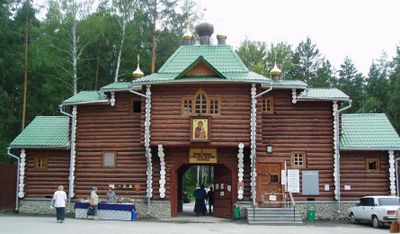
Monastery at Ganina Yama, Orthodox monastery near Yekaterinburg, Russia
The Monastery at Ganina Yama is a complex of seven wooden churches, one for each member of the Romanov family killed in 1918. The main gatehouse is built of dark brown horizontal logs on a partly stone base, with a wide central arch, a green hipped roof and three golden onion domes. A framed panel above the arch bears gold Cyrillic lettering naming the Imperial Fund of Saint Elizabeth Feodorovna.
In the night of 16–17 July 1918, Nicholas II, his family and four servants were shot in the Ipatiev House in Yekaterinburg. Their bodies were driven to the Ganina Yama tract and thrown into the abandoned Mine No. 7 after attempts to destroy them. In 1991 writer Vladimir Soloukhin located the site; a memorial cross was set up with the blessing of Archbishop Melkhisedek. The monastery was founded on 28 December 2000, and the first church was consecrated on 27 December 2000.
Each chapel here is dedicated to a member of the Romanov family, honoring their role as religious martyrs in Orthodox tradition. The site draws pilgrims who light candles and leave flowers, showing how this place has become a spiritual destination for those seeking connection to this history.
The site is open to visitors daily and lies about 15 kilometers north of Yekaterinburg in a remote forest location. Organized tours or private transport are the most practical ways to visit, as public transportation to this area is limited.
The monastery stands beside mine shaft No. 7, the pit where the bodies were thrown in July 1918. The Tsar's Church, built first in 2000, is the closest of the seven churches to this shaft. Its bell tower holds eight bells, each bearing an icon of a family member, donated by singer Alexander Novikov.
The community of curious travelers
AroundUs brings together thousands of curated places, local tips, and hidden gems, enriched daily by 93,468 contributors worldwide.