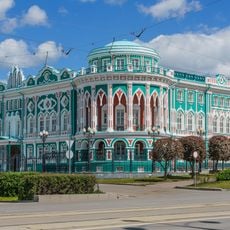
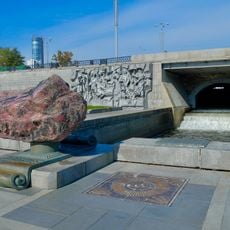
Gorodskoy Prud, reservoir in Russia
Gorodskoy Prud is a reservoir on the Iset River in central Ekaterinburg, created in 1723 as the first water storage on the river. It stretches 3.3 km in length, 0.3–0.4 km in width, with an average depth of 3 m and a maximum depth of 5.5 m at the city dam. The water level is 240.4 m above sea level, and the pond widens gradually toward the south.
The pond was created in 1723 together with the Ekaterinburg factory, making it the first reservoir on the Iset River. The city's plan, set out by Vasily de Gennin in 1726, aligned its main axis with the pond. A stone embankment was built on the west bank in 1845, and the present embankments were designed by architect S. V. Dombrovsky in 1945.
The pond has been painted repeatedly: Ivan Slyusarev depicted it in 1914, and in 1918 the Czech artist J. Vlček, then in Yekaterinburg, made watercolours of the pond with the cathedral in view. In the 1920s and 1930s S. Zakharov, A. Davydov and O. Bernhard followed, and in the 1940s V. Yeliseyev and N. Golubchikov painted its embankments.
The pond stretches 3.3 km from the dam northward, widening toward the south, so the dam end is the deepest point at 5.5 m. A stone embankment was built on the western shore in 1845, and the 1945 embankments by architect S. V. Dombrovsky line the banks. The Olkhovka is the only river still flowing into the northern part.
Until the 1960s the pond held pike, ide, chebak, dace and ruff, a fishery later lost as the city closed in. The pond also entered art: in 1914 I. K. Slyusarev painted "Ekaterinburg City Pond", and in 1918 the Czech artist J. Vlček, then in the city, made watercolours of the pond with the cathedral in view.
The community of curious travelers
AroundUs brings together thousands of curated places, local tips, and hidden gems, enriched daily by 94,795 contributors worldwide.