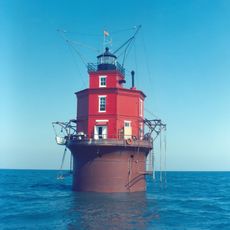
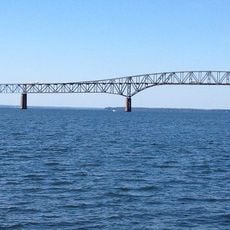
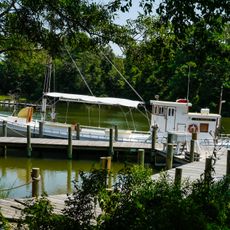
Stingray Point Light, Maritime navigation point at Rappahannock River mouth, Middlesex County, US.
Stingray Point Light was a hexagonal wooden lighthouse supported by screwpiles, standing roughly 34 feet (10 meters) tall with a central lantern room. The lantern housed a sixth-order Fresnel lens that projected light to guide passing vessels.
Congress approved funding in 1853 for lighthouse construction after numerous vessels ran aground near the Rappahannock River entrance. The structure operated from 1858 until 1965, serving as a critical navigation aid in the region.
The lighthouse takes its name from a 1608 incident when explorer John Smith was injured by a stingray while fishing in these waters. This historical origin connects the site to early colonial exploration of the region.
The lighthouse projected a fixed red light visible from about 7 nautical miles away, helping boat captains navigate safely through the channel. Since it stands in water, visiting it requires access by boat from nearby launch points.
During storms, the lighthouse would sway noticeably on its foundation, a condition that keeper Levi Marchant had to manage during his long tenure from 1889 to 1921. This constant motion made the structure both an engineering marvel and a test of the keeper's nerve.
The community of curious travelers
AroundUs brings together thousands of curated places, local tips, and hidden gems, enriched daily by 60,000 contributors worldwide.