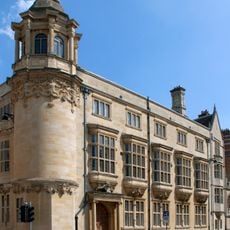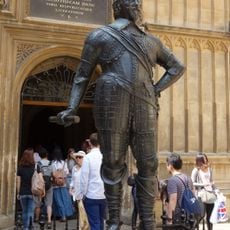
Clarendon Building, Grade I listed university building in Broad Street, Oxford, England
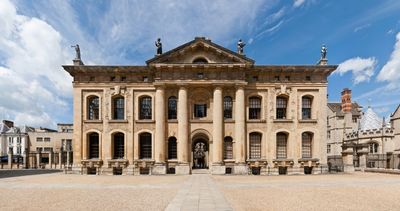
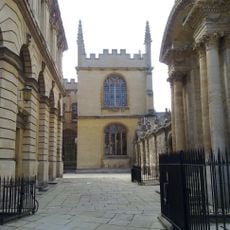
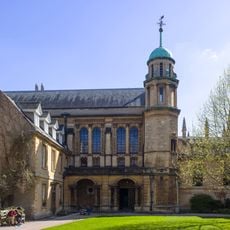
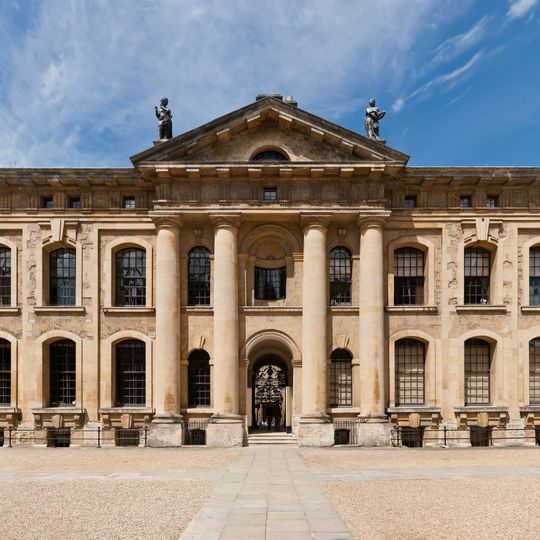
The Clarendon Building is a rectangular neoclassical structure along Broad Street featuring Tuscan columns and a grand portico at its eastern facade. The design displays clean geometric lines and balanced proportions typical of its architectural period.
Nicholas Hawksmoor designed this structure in 1711 as the original home of Oxford University Press, which operated there until moving to Walton Street in the 1820s. Revenue from sales of the Earl of Clarendon's "History of the Great Rebellion" funded the construction, giving the building its present name.
The roof once held nine lead sculptures of the Muses, with two replaced by fiberglass copies in 1974 after damage to the originals. Visitors can still spot these figures from street level and notice the contrast between the older and newer sculptures.
The building now serves as office and meeting space for senior staff of the Bodleian Library, so interior access is not available to visitors. The exterior and roof features are best viewed from Broad Street, where the full facade can be seen from the pavement.
This building was funded in an unusual way: a book by the Earl of Clarendon actually paid for its construction through sales revenue. This type of book-funded architecture was quite rare for a university building during that era.
The community of curious travelers
AroundUs brings together thousands of curated places, local tips, and hidden gems, enriched daily by 90,806 contributors worldwide.