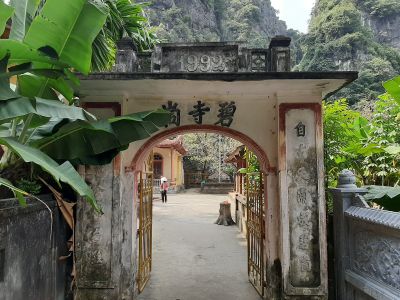
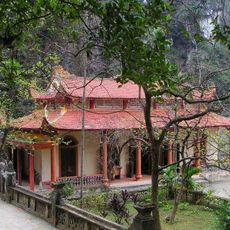
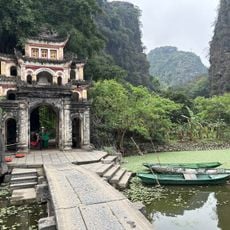
Bich Dong, Buddhist temple complex in Hoa Lư, Ninh Bình Province, Vietnam.
This Buddhist temple complex consists of three separate structures built into and around natural limestone caves, connected by stone pathways that climb through rocky terrain adorned with moss-covered sculptures and flowering trees.
Originally constructed in 1428, the site was abandoned during periods of conflict and later restored in the early 18th century by two Buddhist monks who dedicated themselves to reviving the complex and its religious practices.
The site is designed to represent a symbolic lotus flower, with five surrounding mountains forming its petals, reflecting traditional Vietnamese beliefs in feng shui and the spiritual significance of natural landscapes.
Visitors can reach the complex by walking about 1 to 1.2 miles (2 kilometers) from Tam Coc or by taking a short taxi ride costing approximately 20,000 Vietnamese dong each way.
The middle temple is partly built inside a natural cave and features a copper bell from the 18th century that local tradition says can be rung to bring justice to those wronged.
Location: Phường Nam Hoa Lư
Address: 6W99+C23, Ninh Hải, Hoa Lư, Ninh Bình 430000, Vietnam 430000
Opening Hours: Monday-Sunday 07:30-16:30
GPS coordinates: 20.21746,105.91571
Latest update: December 1, 2025 15:28
Vietnam retains an architectural heritage that spans several centuries. From the Confucian temples in Hanoi to the Cham towers in the country's interior, including the imperial citadels of Hué, these structures reflect influences from Hindu, Chinese, and European traditions that have shaped the land. Each building illustrates a specific period, from the 7th century with Po Nagar's towers to modern constructions of the 20th century. The Temple of Literature in Hanoi, founded in 1070, embodies the Vietnamese educational tradition with its five successive courtyards. In Hué, the Thien Mu Pagoda has stood since 1601 with its seven-story tower rising 70 feet (21 meters) over the Parfum River. The Cham towers of Binh Dinh and Nha Trang showcase the craft of this civilization through their brick ornaments and stone sculptures. The port city of Hoi An features an architectural ensemble from the 15th century, combining Chinese, Japanese, and European styles. These sites offer a tangible journey through the country's architectural and cultural evolution.
Tam Cốc-Bích Động
119 m
Bich Dong Pagoda
148 m
Tam Cốc – Bích Động
225 m
Thien Cung Cave
231 m
Nice, quiet, field
283 m
Scenic viewpoint
1.8 km
Ca Grotto Cave
2 km
Vai Gioi Cave
1.6 km
Linh Coc Boat trip
493 m
Rice fields
1 km
End of Tam Coc Boat Tour
1.9 km
Hai Grotto Cave
1.7 km
Scenic viewpoint
96 m
Scenic viewpoint
856 m
Động Tam Cốc
494 m
Ba Grotto Cave
1.9 km
Cave viewpoint
501 m
Scenic viewpoint
1.9 km
Scenic viewpoint
1.9 km
Scenic viewpoint
2 km
Scenic viewpoint
1.7 km
Scenic viewpoint
1.8 km
Scenic Viewpoint
1.5 km
Scenic viewpoint
1.6 km
Scenic viewpoint
1.5 km
Thien Huống Dong
1.8 km
Memorial
1.8 km
Wayside shrine, Buddhism
1.7 kmReviews
Visited this place? Tap the stars to rate it and share your experience / photos with the community! Try now! You can cancel it anytime.
Discover hidden gems everywhere you go!
From secret cafés to breathtaking viewpoints, skip the crowded tourist spots and find places that match your style. Our app makes it easy with voice search, smart filtering, route optimization, and insider tips from travelers worldwide. Download now for the complete mobile experience.
A unique approach to discovering new places❞
— Le Figaro
All the places worth exploring❞
— France Info
A tailor-made excursion in just a few clicks❞
— 20 Minutes