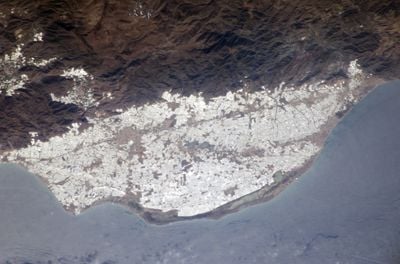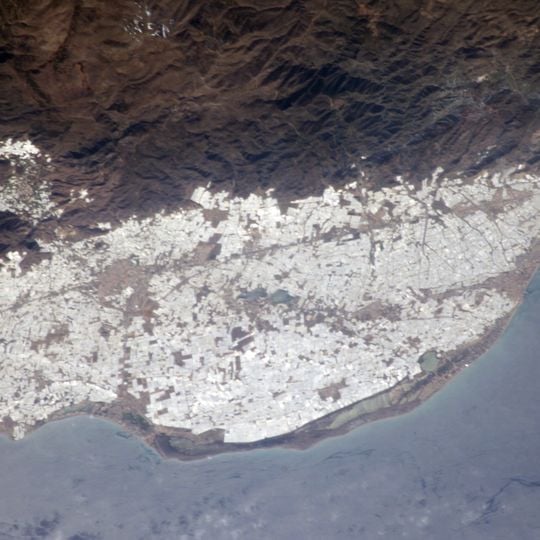
Sea of plastic, Extensive greenhouse region in Almería, Spain.
This vast agricultural zone spans roughly 20 miles (32 kilometers) across southeastern Spain, covering an estimated 30,000 acres (12,000 hectares) of plastic-covered greenhouses that produce tomatoes, peppers, cucumbers, and other vegetables year-round for European markets.
The transformation of this arid landscape began in the early 1960s when local farmers experimented with plastic sheeting to protect crops from harsh desert winds, leading to a rapid expansion during the 1970s after government reconstruction aid following devastating 1973 floods.
This agricultural hub relies heavily on immigrant labor from North Africa and other regions, creating a diverse community that has grown from a few thousand residents to over 80,000 people by the early 2010s, though this demographic shift has sometimes sparked social tensions.
The region generates approximately 4 million metric tons of produce annually and contributes around $5.1 billion to Spain's agricultural exports, with most shipments heading to Germany, the United Kingdom, France, and Italy throughout the year.
From orbit, NASA satellites capture this area as a distinct white expanse reflecting sunlight across the desert terrain, making it one of the few human-made agricultural landscapes clearly visible from space due to the sheer concentration of reflective plastic structures.
The community of curious travelers
AroundUs brings together thousands of curated places, local tips, and hidden gems, enriched daily by 60,000 contributors worldwide.