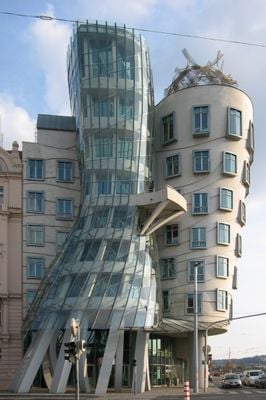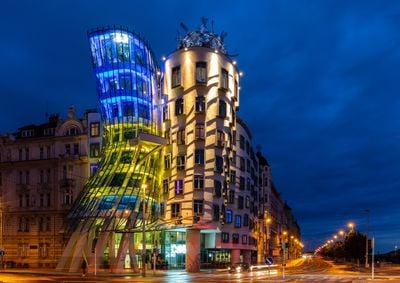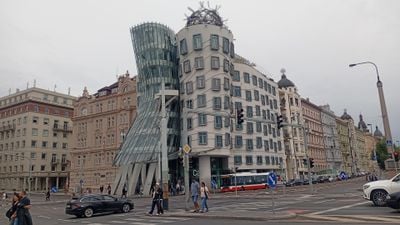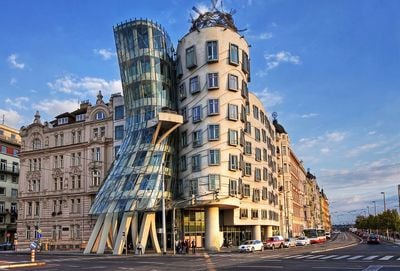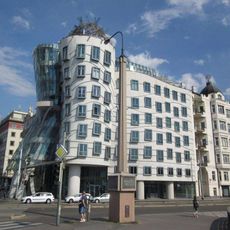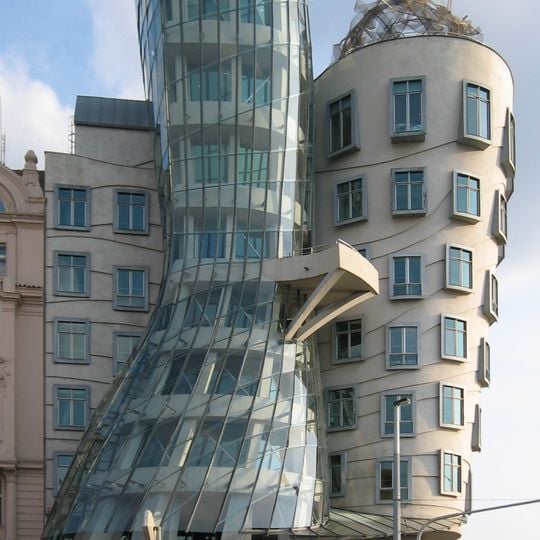
Dancing House, Deconstructivist office building in New Town, Czech Republic.
Two contrasting towers form the structure: a glass cylinder with curved forms and a concrete segment with perpendicular lines and supporting columns. The glass tower leans toward the adjacent concrete body, creating an illusion of movement. The construction rises on a corner along the Vltava River and departs markedly from surrounding historic buildings, establishing an architectural dialogue between old and new.
Construction took place between 1994 and 1996 on a site where a 19th century building had been destroyed during a US bombing raid in 1945. Czech architect Vlado Milunić collaborated with American architect Frank Gehry to create a structure marking Prague's transition to a market economy. The project received support from then president Václav Havel, who lived in the neighborhood.
Local residents initially nicknamed the structure "Ginger and Fred" after the famous dance duo, with each tower representing one dancer. The building sparked intense debate about modern architecture in Prague following its completion, as many residents and architects feared it would disrupt the historic cityscape. Today the structure serves as a landmark of democratic renewal after 1989 and a symbol of Czech openness to contemporary international architecture.
The structure stands at Jiráskovo náměstí 1981/6 and houses office spaces, a hotel with luxury suites, and a seventh floor restaurant with a viewing terrace. Tram lines 14 and 17 stop nearby at Jiráskovo náměstí station. Public access is limited to the restaurant and ground floor gallery, while office areas remain closed to visitors. Reservations are recommended for the rooftop restaurant, particularly during evening hours.
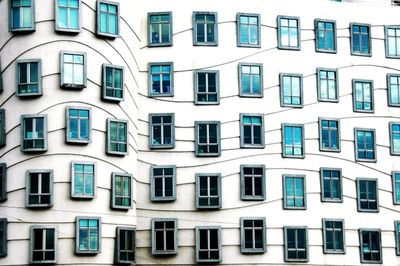
The construction consists of 99 differently shaped concrete panels, each with an individual form to create the characteristic dynamic movement appearance. This technical achievement required precise calculations and fabrication techniques, as no panel resembles another. Engineers had to develop special fixtures to stabilize the irregular shapes during installation and ensure the structural integrity of the entire building.
Location: New Town
Location: Prague 2
Inception: 1996
Architects: Vlado Milunić, Frank Gehry
Architectural style: deconstructivism
Website: http://tadu.cz
GPS coordinates: 50.07556,14.41417
Latest update: December 1, 2025 08:16
20th and 21st-century architecture has transformed city centers with structures that push engineering boundaries. Observation towers like the Seattle Space Needle and experimental residential complexes like Habitat 67 in Montreal demonstrate the evolution of construction techniques. Architects have explored new forms using materials such as steel, glass, and concrete, creating structures that meet the growing demands of metropolitan areas. This collection includes buildings that marked their time with innovative design. In Barcelona, Antoni Gaudí's Casa Milà features a wavy facade that breaks traditional norms, while in London, 30 St Mary Axe incorporates energy-saving technologies into its 180-meter structure. From Bilbao's Guggenheim Museum clad in titanium to artificial islands shaped in the Persian Gulf in Dubai, these projects illustrate the diversity of architectural approaches worldwide. Each building reflects its urban context while offering solutions to technical and functional challenges of its era.
This collection presents significant architectural works from different periods and continents. From medieval cathedrals to contemporary skyscrapers, the selection documents the technical and aesthetic development of building design. The listed buildings were created by influential architects and have shaped the evolution of modern architecture. The list includes religious structures such as Gothic churches and monasteries, public facilities like museums and concert halls, and residential buildings that established new construction standards. Each building demonstrates particular structural solutions or stylistic features that contribute to understanding architectural history. The selection offers insights into various building styles, materials and construction methods.
Architecture does not have to follow straight lines and right angles. This collection presents buildings that stand out through their form: domes, spirals, tilted facades or organic structures that recall animals or plants. From Gaudí's mosaic covered works in Barcelona to the stacked concrete cubes of Habitat 67 in Montreal or the conical trulli of Alberobello, these structures demonstrate alternative approaches to construction. Some emerged from technical necessity, such as the temporary cardboard cathedral in Christchurch after the 2011 earthquake. Others are artistic statements: the Guggenheim Museum in Bilbao with its titanium plates, the Dancing House in Prague or the cubist houses in Rotterdam. In Đà Lạt, the Crazy House transforms tree trunks and caves into habitable spaces, while the Atomium in Brussels represents a magnified iron crystal. These structures attract visitors but also raise questions about function and livability. The Longaberger Basket Building in Ohio takes the form of a seven story basket. The Lotus Temple in New Delhi uses concrete shells to form 27 petals. The Aldar headquarters in Abu Dhabi resembles a circular coin. These buildings expand the definition of what architecture can be.
Postmodern architecture emerged in the 1970s as a response to the rigid principles of modernism, reintroducing color, ornament, and historical references into contemporary building design. The movement evolved over decades, producing structures that challenge conventional forms and experiment with different materials and surfaces. These buildings demonstrate varied approaches to design, from playful facades to complex geometric constructions, showing how architects employ new technologies while engaging with historical stylistic elements. The collection includes cultural institutions such as the Guggenheim Museum Bilbao and Casa da Música in Porto, public buildings like Seattle Central Library and Almere City Hall, and religious structures such as the Jubilee Church in Rome. Other examples include the SIS Building in London, Dancing House in Prague, and Niterói Contemporary Art Museum in Rio de Janeiro. The Louvre Pyramid in Paris and the Wexner Center for the Arts in Columbus show different interpretations of postmodern principles. The Piazza d'Italia in New Orleans with its colored colonnades and the Portland Building with its decorated facade represent early postmodern works in the United States.
Frank Gehry designs buildings with curved metal facades, irregular forms and experimental construction methods. His work defines urban spaces from Bilbao to Los Angeles. The exterior surfaces use titanium, steel or glass formed into wave-like or folded volumes. The interior spaces accommodate art collections, concert halls and commercial offices. The Guggenheim Museum in Bilbao displays titanium panels that reflect the light of the Basque coast. The Walt Disney Concert Hall in Los Angeles combines stainless steel surfaces with wooden acoustics for the Los Angeles Philharmonic. The Vitra Design Museum in Weil am Rhein demonstrates his early approaches with white stucco surfaces and angled walls. The buildings emerge through computer-aided design that translates complex geometries into buildable structures.
Prague features historical monuments from the Middle Ages to the 20th century. The medieval center includes the Old Town Square with its astronomical clock. The royal castle overlooks the city from its hill. Charles Bridge connects the two banks of the Vltava. Religious buildings, museums, and theaters illustrate Gothic, Baroque, and modern architecture.
Contemporary skyscrapers push the boundaries of vertical architecture with structures that challenge gravity through rotations, twists, and spirals. These buildings reflect advances in structural engineering and allow for residential, commercial, and cultural structures with facades that sometimes rotate 90 degrees from base to top. The Cayan Tower in Dubai stands out with its 1,014-foot height and a full rotation across 73 floors, while the Shanghai Tower reaches 2,073 feet thanks to a twisted shape that reduces wind pressure. These structures can be found worldwide. The Absolute World Towers in Mississauga, Canada, feature wavy designs that earned them the nickname Marilyn Monroe Towers. In Prague, the Dancing House impresses with its curved glass walls contrasting with surrounding historic architecture. The Soumaya Museum in Mexico City displays an asymmetric form covered with thousands of hexagonal aluminum panels. The Lakhta Tower in Saint Petersburg and Capital Gate in Abu Dhabi complete this international selection, illustrating how contemporary architects transform city skylines through engineering feats that combine aesthetics with structural performance.
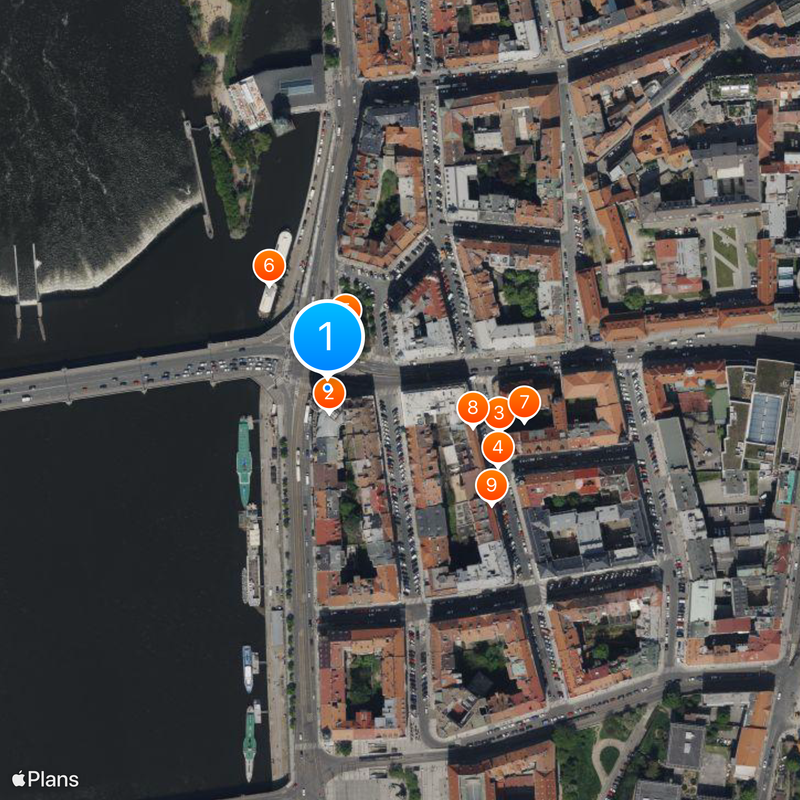
Dancing House
17 m
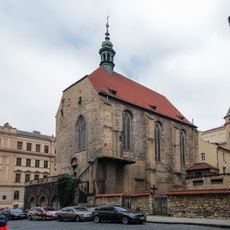
St. Wenceslas Church in Zderaz
123 m
Hlávkova kolej
131 m
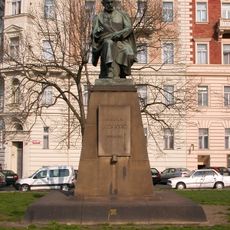
Statue of Alois Jirásek, Prague
42 m
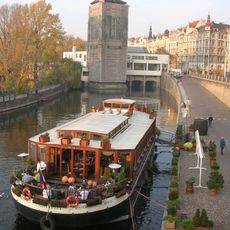
Botel Matylda
82 m
Galerie Via Art
138 m
Dittrichova 19
105 m
Dittrichova 13
140 m
Rašínovo nábřeží 78
40 m
Jiráskovo náměstí 1
105 m
Nájemní domy V. Havla Rašínovo nábřeží
116 m
Jiráskovo náměstí 2
102 m
Gorazdova 22
70 m
Památník Jiráskova mostu v Praze
37 m
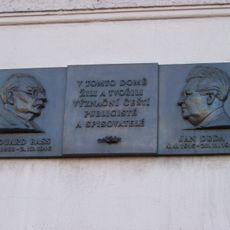
Pamětní deska Eduarda Basse a Jana Drdy v Resslově ulici v Praze
23 m
Energovod
57 m
Rašínovo nábřeží 70
115 m
Gorazdova 13
83 m
Gorazdova 18
98 m
Pamětní deska Jaroslava Vrchlického na Rašínově nábřeží v Praze
99 m
Sloup v Ditrichově ulici v Praze
121 m
Pamětní deska Františka J. Řezáče v Resslově ulici v Praze
129 m
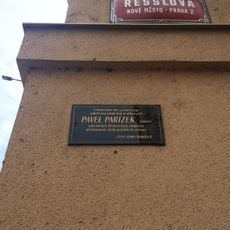
Pamětní deska Pavla Pařízka v Resslově ulici v Praze
92 m
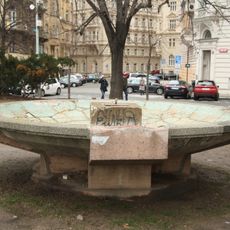
Kašna na Jiráskově náměstí v Praze
37 m
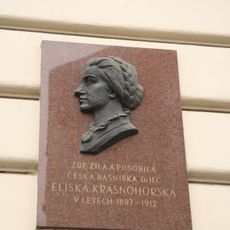
Pamětní deska Elišky Krásnohorské
116 m
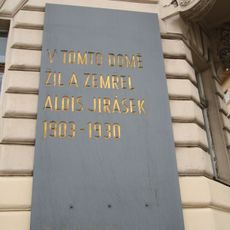
Pamětní deska Aloise Jiráska
54 m
Pamětní deska Otakara Runy
147 m
Pamětní deska Josefa Hlávky
145 mReviews
Visited this place? Tap the stars to rate it and share your experience / photos with the community! Try now! You can cancel it anytime.
Discover hidden gems everywhere you go!
From secret cafés to breathtaking viewpoints, skip the crowded tourist spots and find places that match your style. Our app makes it easy with voice search, smart filtering, route optimization, and insider tips from travelers worldwide. Download now for the complete mobile experience.
A unique approach to discovering new places❞
— Le Figaro
All the places worth exploring❞
— France Info
A tailor-made excursion in just a few clicks❞
— 20 Minutes