Villa Tugendhat

Log in to your account

AroundUs is a community-driven map of interesting places, built by curious explorers like you. It grows with every review, story, and photo you share.
Connect to save your favorite spots, contribute locations, and create personalized routes.
By continuing, you accept our Terms and Conditions and our Privacy Policy
Add to collection
Map
Suggest a change
Share

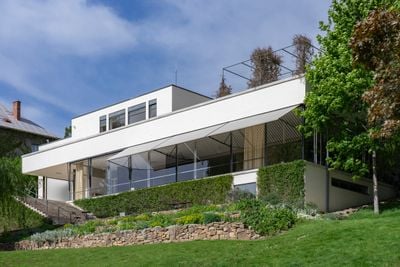
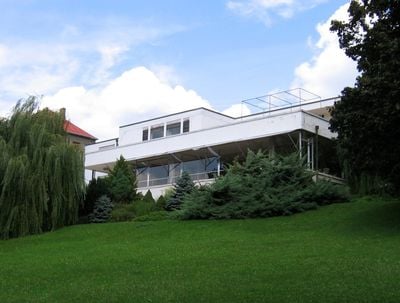
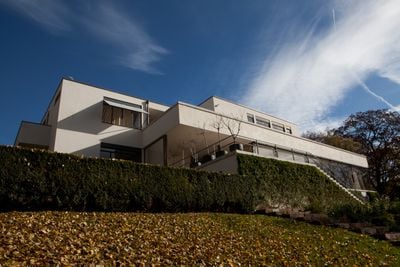
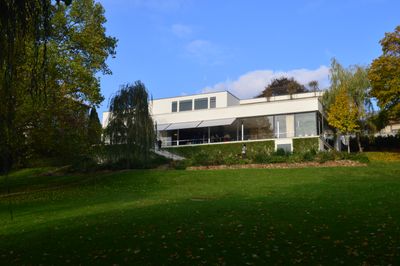
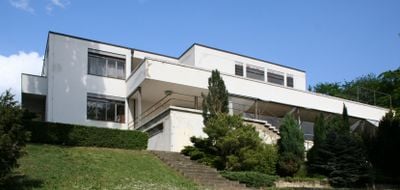
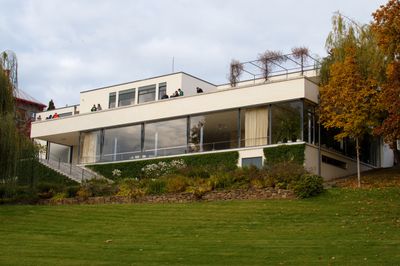
Villa Tugendhat, Functionalist museum building in Černá Pole district, Brno, Czech Republic.

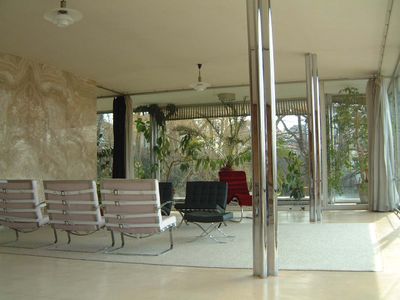
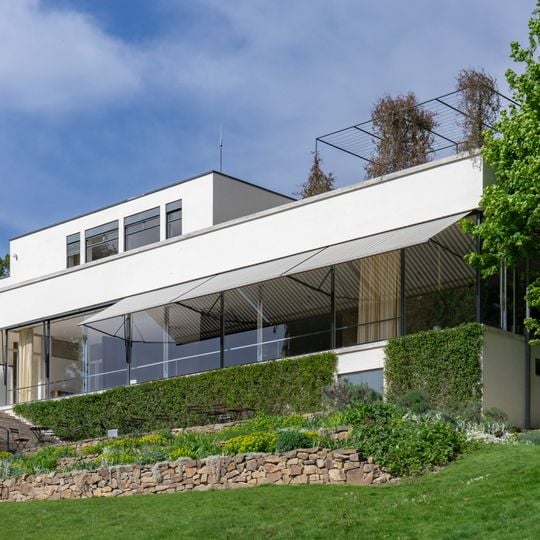
Villa Tugendhat is a functionalist museum building in the Černá Pole district of Brno, Czech Republic, recognized as a World Heritage Site and national cultural monument. The three-story structure displays open floor plans with ceiling-height windows, a reinforced concrete frame and natural materials including walls of Moroccan onyx plus partitions of rosewood and Macassar ebony.

Ludwig Mies van der Rohe and Lilly Reich finished the residential project in 1930 for Fritz and Greta Tugendhat, who departed the country in 1938. During World War II the building served military purposes before undergoing restoration decades later to become a museum and cultural monument.

The name honors the Tugendhat family who commissioned it as their home, while the interior reveals a vision of modern living through its open plan and continuous flow between areas. Visitors today see how residents once abandoned traditional room divisions and instead used materials such as onyx and metal to define separate zones.

Visitors choose from three guided tour options lasting 40, 60, or 90 minutes, with advance booking recommended due to limited capacity. The visit covers multiple floors, so comfortable footwear is advisable, and the interior maintains a quiet atmosphere that encourages focused observation.

A glass wall can be lowered mechanically into the basement, a technical solution that was novel for residential architecture in 1930. The mechanism allows the living space to open or close as needed and demonstrates the period enthusiasm for technical innovation in everyday life.

Location: Brno-sever

Location: Černá Pole

Inception: 1930

Architects: Ludwig Mies van der Rohe, Lilly Reich

Architectural style: functionalism

Accessibility: Wheelchair accessible

Address: Černopolní 237/45, 613 00 Brno

Opening Hours: March-October: Tuesday-Sunday 10:00-18:00; November-February: Tuesday-Sunday 09:00-17:00

Phone: +420515511015

Email: info@tugendhat.eu

Website: https://tugendhat.eu

GPS coordinates: 49.20722,16.61583

Latest update: December 4, 2025 23:43

Architecture: famous buildings, modern and historical structures

This collection presents significant architectural works from different periods and continents. From medieval cathedrals to contemporary skyscrapers, the selection documents the technical and aesthetic development of building design. The listed buildings were created by influential architects and have shaped the evolution of modern architecture. The list includes religious structures such as Gothic churches and monasteries, public facilities like museums and concert halls, and residential buildings that established new construction standards. Each building demonstrates particular structural solutions or stylistic features that contribute to understanding architectural history. The selection offers insights into various building styles, materials and construction methods.

Architecture by Mies Van der Rohe worldwide

Ludwig Mies van der Rohe shaped 20th-century architecture. His buildings stand in European and North American cities and show his approach: clear geometry, steel and glass combined with open floor plans. Each project follows the principle of reducing to the essential and defining space through structure. In the United States, he designed the Farnsworth House in Illinois, a residence with glass walls set in a wooded area. In Chicago, he created several buildings, including Crown Hall on the Illinois Institute of Technology campus and the residential high-rises on Lake Shore Drive. In New York, he developed the Seagram Building together with Philip Johnson, an office tower made of bronze and glass. Additional projects took him to Washington, Baltimore, Detroit, Montreal, and Toronto. In Europe, he built villas, museums, and exhibition structures. The Barcelona Pavilion was a temporary structure for the 1929 World's Fair, later reconstructed. Villa Tugendhat in Brno is now a World Heritage site. In Berlin, he built the New National Gallery, a museum with a large glass roof. In Krefeld, he designed Haus Lange and Haus Esters for private clients.

Reviews

Visited this place? Tap the stars to rate it and share your experience / photos with the community! Try now! You can cancel it anytime.

« Villa Tugendhat - Functionalist museum building in Černá Pole district, Brno, Czech Republic » is provided by Around Us (aroundus.com). Images and texts are derived from Wikimedia project under a Creative Commons license. You are allowed to copy, distribute, and modify copies of this page, under the conditions set by the license, as long as this note is clearly visible.

Discover hidden gems everywhere you go!

From secret cafés to breathtaking viewpoints, skip the crowded tourist spots and find places that match your style. Our app makes it easy with voice search, smart filtering, route optimization, and insider tips from travelers worldwide. Download now for the complete mobile experience.
Around Us App Screenshot

A unique approach to discovering new places

Le Figaro

All the places worth exploring

France Info

A tailor-made excursion in just a few clicks

20 Minutes