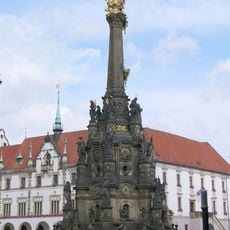
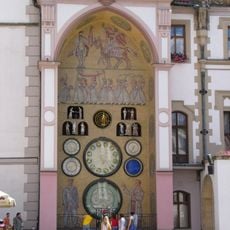
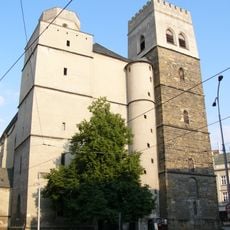
Fontanny Ołomuńca, Baroque fountains in Olomouc, Czech Republic.
Fontanny Ołomuńca is a group of Baroque fountains in Olomouc's Old Town, seven of them large compositions from the last quarter of the 17th to the first half of the 18th century, each with a different-shaped stone basin. The oldest, Neptune's Fountain on Dolní náměstí, was made in 1683 by sculptor Michael Mandík and stonemason Václav Schüler; the largest, Caesar's Fountain on Horní náměstí, was completed in 1725.
The Baroque fountains were built between 1683 and 1725, before the city had a piped water supply, which only arrived at the very end of the 19th century. Neptune's Fountain of 1683 came first, followed by Hercules in 1687; the six main fountains were placed at busy points of the historic centre and have been national cultural monuments since 1995.
The figures are Baroque, not Renaissance: Neptune (1683) holds a trident pointing down to calm the sea, Hercules (1687) grips a chequered eagle, the city's symbol, while fighting the Lernaean Hydra, and Caesar recalls the legend that he founded Olomouc, called Julimontium. The Tritons fountain was inspired by Bernini's Fontana del Tritone in Rome.
The six main Baroque fountains stand in the historic core: Neptune and Jupiter on Dolní náměstí, Hercules and Caesar on Horní náměstí, the Tritons on náměstí Republiky and the Dolphin fountain nearby. They are drained in winter, so water flows only in the warmer months.
The Arion Fountain is one of the newest additions to Olomouc's water features, dating from the first decade of the 21st century, alongside the Spring of Living Water of St. John Sarkander. Unlike the Baroque fountains, it does not depict ancient mythology but refers to the Greek poet Arion, and it stands out among the roughly 25 public fountains and springs counted in the city in 2011.
The community of curious travelers
AroundUs brings together thousands of curated places, local tips, and hidden gems, enriched daily by 92,148 contributors worldwide.