Pachtů z Rájova, Baroque palace in Old Town, Czech Republic
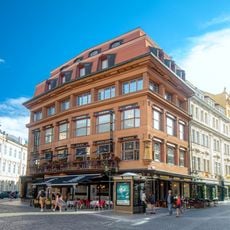
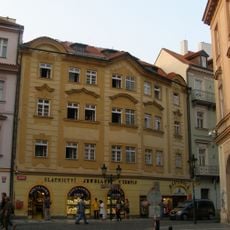
Pachtů z Rájova is a baroque palace at the corner of Celetná Street and Ovocný trh, formed from an older complex that once housed a royal mint. Its Celetná facade has nine axes and a monumental portal with miner and soldier figures by Ignác F. Platzer supporting a balcony with a rococo metal railing. The later 19th-century wing facing Ovocný trh has 17 axes and three three-axis risalits.
A house of the Velflovic family stood here until 1409, when King Wenceslas IV acquired it; in 1420 the Old Town confiscated it and turned it into a mint that operated until 1434. Queen Johana, wife of Jiří z Poděbrad, later used it as her court. In 1737 Josef Ignác Langer began the rococo palace, probably designed by Kilián Ignác Dientzenhofer, and after 1755 Count František Josef Pachta had Jan Josef Wirch rebuild it in late baroque form.
The palace's name comes from Count František Josef Pachta, who had it rebuilt in the late Baroque style after 1755. The building now houses the District Courts for Prague 1 and Prague 7, so visitors see a working courthouse rather than a museum.
The palace stands at the corner of Celetná 587/36 and Ovocný trh 587/14, and the district courts for Prague 1 and Prague 7 still sit in the complex, so the interiors are working courtrooms rather than a hotel. Visitors can view the Celetná facade with its nine axes and the three-part portal from the street; the arcade in Celetná was pierced in 1938.
The three-part portal from the 1755–1759 rebuilding carries sculptures of miners and soldiers by Ignác F. Platzer; Petr Prachner reworked the figures in 1784. The metal rococo balcony railing above it survives from the same campaign.
The community of curious travelers
AroundUs brings together thousands of curated places, local tips, and hidden gems, enriched daily by 92,304 contributors worldwide.