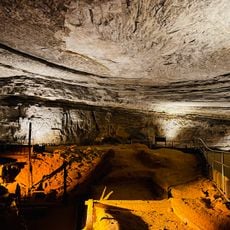
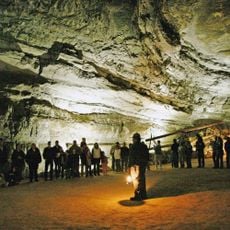
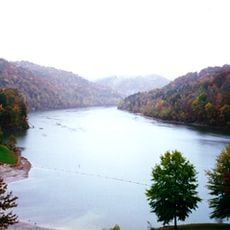
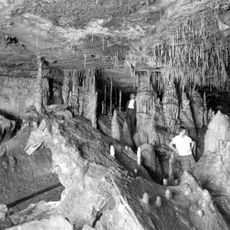
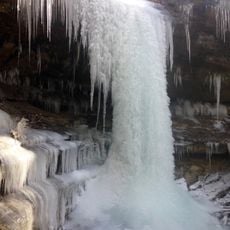
Cedar Sink, Natural sinkhole in Mammoth Cave National Park, Kentucky, United States.
Cedar Sink is a collapse sinkhole in Mammoth Cave National Park, Edmonson County, Kentucky, with vertical walls dropping 300 feet (91 m) from the sandstone plateau to the floor. The 7-acre (2.8 ha) bottom exposes the top of the Ste. Genevieve Limestone, while the breached Big Clifty Sandstone caprock and Girkin Formation limestone show in the walls above.
Cedar Sink lies in Mississippian limestone, about 358.9 to 323.2 million years old. The Big Clifty Sandstone caprock was breached, exposing the Girkin Formation and creating a relief of about 200 feet below the plateau; the floor exposes the top of the Ste. Genevieve Limestone another 100 feet down. Weakening of the ceiling and formation of Smith, Cedar Spring and Woolsey valleys caused the ancestral master trunk to collapse, and continuous flow undermined the sink further.
Cedar Sink is a karst window: the stream that once ran entirely underground is exposed at the bottom of the depression and can be seen from the overlook, and occasionally at six other spots in the sink, depending on the season and recent rain. Before a major storm in May 1984, all the water here flowed only to Turnhole Spring.
The trail to the sinkhole is roughly 2.5 kilometers and requires descending and climbing back up about 295 steps, taking around an hour total. Wear good footwear since the paths are steep and can be slippery.
Cedar Sink is a karst window: the stream that once ran entirely underground is exposed at the surface. Before a major storm in May 1984, all water in the sink flowed only to Turnhole Spring; the drainage is fed chiefly by two sub-basins, Mill Hole and Procter Cave.
The community of curious travelers
AroundUs brings together thousands of curated places, local tips, and hidden gems, enriched daily by 92,746 contributors worldwide.