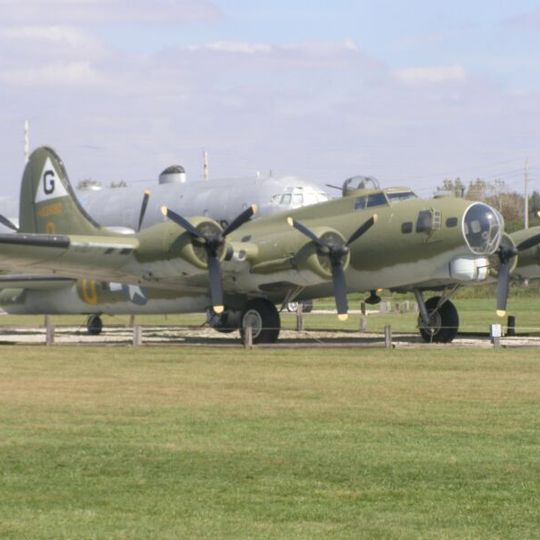
44-83690, World War II bomber aircraft in Peru, Indiana, US.
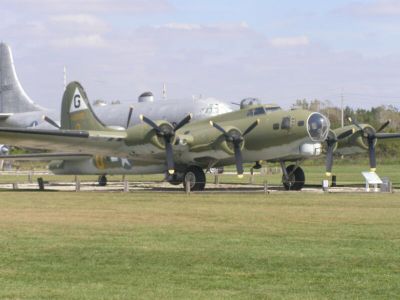
The Boeing B-17G Flying Fortress 44-83690 is a Douglas-built B-17G-95-DL heavy bomber with an aluminum-clad fuselage, four radial engines with General Electric B-22 turbochargers, and a wingspan of 103.75 feet. Its Plexiglas nose cone, raised cockpit, dorsal navigator's blister, and staggered waist gunner windows are visible; the tail fin stands 19.17 feet tall above a retractable tail-wheel landing gear.
Built by Douglas in Long Beach as a B-17G-95-DL, it was delivered on 9 May 1945 to Patterson AFB and stored. In July 1950 it was converted at Olmstead AFB into a DB-17G drone director, then flew with the 3200 Drone Squadron at Eglin AFB and took part in Operation Greenhouse nuclear tests at Enewetak in 1951. Removed from Air Force inventory in August 1960, it was displayed at Grissom AFB from 1961 and listed on the National Register of Historic Places on 29 June 1993.
At Grissom Air Force Base the plane was displayed with tail number 42-31255 and nose art reading "Miss Liberty Belle" on the left side and "Flak Magnet" on the right, added around 1983. Visitors to the Museum of Aviation can now see the airframe being reassembled by a restoration team funded entirely by donations.
The bomber is at the Museum of Aviation near Robins Air Force Base in Georgia, not in Indiana. It arrived there in pieces in August 2015 and is being reassembled during a restoration funded by donations, so parts of the airframe may be under work rather than on open display. Check the museum's opening arrangements before travelling.
After the war, this aircraft was converted into an experimental test plane used for remote-controlled aircraft research. This transformation fundamentally changed its role from a combat aircraft to a testing platform.
The community of curious travelers
AroundUs brings together thousands of curated places, local tips, and hidden gems, enriched daily by 93,933 contributors worldwide.