Lombard Plantation, West Indian style Creole manor in Bywater, New Orleans, US
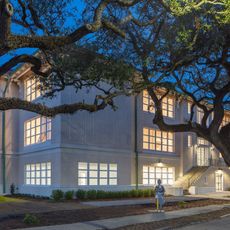
Lombard Plantation is a West Indian style Creole manor house elevated on pillars with thick plaster walls and deep roof overhangs that provide shade and weather protection. The structure features Norman trussing in its attic section and is surrounded by a cast iron cornstalk fence that marks the property boundary.
Joseph Lombard père acquired the tract on October 25, 1825, then sold the improved land with the plantation house to his son Joseph Guillaume for $13,000, the building valued at $5,500. The family sold it in 1833 to Phillipe Guesnon for $50,000. The Durands reassembled the property from 1843 to 1864, and Charles Caffin controlled it from 1864 to 1880. In 1878 the parcel was subdivided and shotgun houses were built within its boundaries.
The name comes from Joseph Lombard père, who bought the tract for his son on October 25, 1825. The 1835 sale to Jean Louise Grasse described it as "une belle maison". The main floor held a reception room, a dining room seating twelve, a family dining room, a salon, a bedroom and an office.
The Lombard House stands in Bywater, in the Ninth Ward, on ground that once ran 1.5 arpents back from the Mississippi toward Lake Pontchartrain. The former front yard became a cinder block bikers bar in the late 1950s, sold in 2002 and demolished at once; the former backyard was bought back after Hurricane Katrina. Look for the house and its small yard with cistern foundations.
The distinctive cast iron cornstalk fence was added between 1864 and 1880 by Charles Caffin and remains one of the rare examples of this decorative style in the region. This particular ironwork is often overlooked despite being a notable piece of craftsmanship that defines the property boundary.
The community of curious travelers
AroundUs brings together thousands of curated places, local tips, and hidden gems, enriched daily by 94,289 contributors worldwide.