St. Claude Avenue Bridge, Dual railway and road bridge in New Orleans, Louisiana
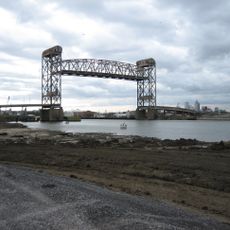
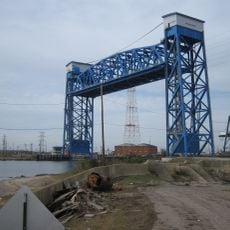
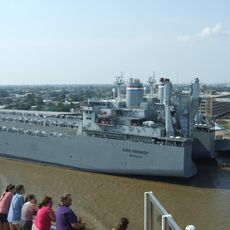
The St. Claude Avenue Bridge is a dual-purpose structure in New Orleans that carries both rail and road traffic over the Industrial Canal. The bascule system allows sections of the bridge to raise, permitting boat passage underneath.
The structure was built in 1919 by Bethlehem Steel Bridge Corporation, originally featuring two pairs of railroad tracks in the center with lanes on either side. Over time, the design was modified to meet changing transportation needs.
The bridge marks the boundary between the Upper Ninth Ward, including Bywater, on the upriver side, and the Lower Ninth Ward on the downriver side. After Hurricane Katrina in 2005, residents of the flooded Lower Ninth Ward crossed it on foot to reach dry ground near the river, and for months it was the only open direct route between that neighborhood and the rest of New Orleans.
Crossing requires patience, as the bridge's lifting mechanism can cause delays, particularly during peak hours. Pedestrians and cyclists should note that the structure is primarily designed for vehicles, and alternative routes may offer easier passage.
A notable feature is the unusual arrangement of traffic lanes, where one lane passes through the truss structure of the bridge itself. This design is uncommon and creates an interesting visual experience when crossing.
The community of curious travelers
AroundUs brings together thousands of curated places, local tips, and hidden gems, enriched daily by 94,411 contributors worldwide.