Keweenaw Waterway Upper Entrance Light, Historic lighthouse in McLain State Park, Hancock Township, Michigan, United States
Keweenaw Waterway Upper Entrance Light stands on a circular steel sheet-pile caisson about 50 feet across and 45 feet tall, filled with rock and capped by a concrete deck roughly 15 feet above Lake Superior. On the deck sits a white reinforced-concrete fog signal building, 11 feet tall and about 34 by 34 feet, with clipped corners and a double-door entry. Centered on it rises a five-story steel tower of standardized 1930s Bureau of Lighthouses design, its lower story rectangular with clipped corners before the sides curve inward to a narrow shaft pierced by port lights; the flat roof carries an open-air VRB-25 beacon.
The light began operation in 1950 as a replacement for an earlier structure from 1874, marking a technological shift for regional waterway navigation. Automated systems were added during the 1970s to improve its operational efficiency.
The light is a pierhead beacon on the eastern breakwater at the mouth of the Keweenaw Waterway, guiding boats between Lake Superior and the Portage River. Its 1930s Streamlined Moderne tower design, drawn from a standard U.S. Bureau of Lighthouses plan, marks it as a product of federal navigation work. It was listed on the National Register of Historic Places on 18 July 2014.
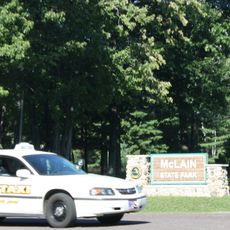
The light can be viewed from McLain State Park, located west of Hancock along Highway 203. Interior access is not available, but the exterior can be seen clearly from the waterfront area.
The tower's beacon is a VRB-25 mounted on the flat roof, and the French sources give its light a focal height of 25 m, a white flash every 15 seconds and a range of 13 nautical miles. A fog horn sounds one signal every 15 seconds in fog.
The community of curious travelers
AroundUs brings together thousands of curated places, local tips, and hidden gems, enriched daily by 92,845 contributors worldwide.