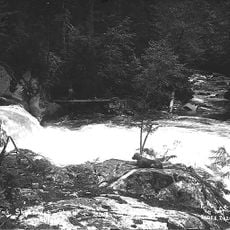
White Chuck Cinder Cone, Cinder cone in Snohomish County, United States.
White Chuck Cinder Cone is a volcanic formation in Snohomish County built from lava fragments ejected from a single vent opening. The cone rises to approximately 1834 meters and displays the characteristic conical shape created through repeated volcanic activity.
The volcanic formation developed several thousand years ago through explosive eruptions, with scientific analysis of glacial erosion suggesting an age between 2000 and 17000 years. Documentation of the formation as a distinct geological feature occurred in 1934, after which researchers began detailed study of its structure.
The name comes from the White Chuck River, whose headwaters lie nearby; the cone itself has no recorded traditional name in the sources. Its existence was first reported in 1934 by Everett Houghland, and the date of that report is the main human landmark attached to the feature. Visitors today see a small, glacially worn cone rather than an active vent.
The cone is accessible via established trails that allow visitors to view the volcanic landscape firsthand. The best time to visit is from early summer through early fall, when trails are clearer and easier to navigate.
The structure clearly shows how lava fragments of varying sizes accumulate gradually around a central vent. This natural buildup makes the cone a particularly instructive example of volcanic processes occurring in the region.
The community of curious travelers
AroundUs brings together thousands of curated places, local tips, and hidden gems, enriched daily by 93,624 contributors worldwide.