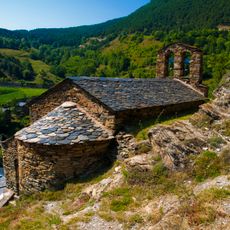
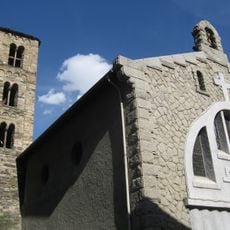
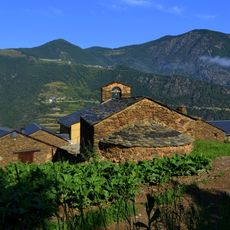
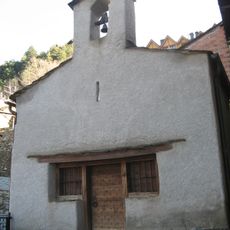
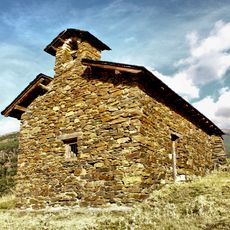
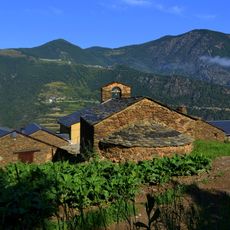
Església de Sant Serni de Nagol, Romanesque church in Nagol, Sant Julià de Lòria, Andorra.
Església de Sant Serni de Nagol is a Romanesque church built before 1055, with a rectangular nave, a semicircular apse and a two-opening bell gable. The nave, 9.34 m long, has a two-slope roof of exposed wooden beams and trusses replacing the original barrel vault; the apse, 11.5 m, is built of slate blocks. A round-arched door opens on the south facade, where a granite holy-water basin is set into the wall, and a porch with a single-slope roof stands in front.
The church was built before 1055, when Bishop Guillem Guifré of Urgell consecrated it; the act of consecration, found in 1979 inside a wooden reliquary in the altar, is the oldest written document kept in Andorra's national archives. The apse, nave and porch were substantially reworked in the 17th and 18th centuries, and the building was listed as a Bé d'interès cultural on 16 July 2003.
The church preserves original altars and Romanesque wall paintings visible in the eastern apse and along the northern wall. These artistic elements show how worshippers shaped the sacred space over the centuries.
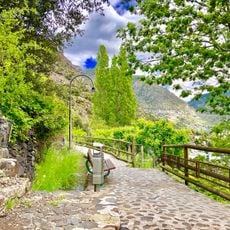
The church stands at Nagol, above Sant Julià de Lòria, and is reached on foot along a mountain path; the last stretch climbs steadily, so allow time for the ascent. The building is small and usually unstaffed, and the Romanesque paintings in the apse are fragments on the walls rather than a full scheme.
The church once held three retables from different periods; the 16th-century one was later moved to the foot of the church, and all are now kept in the reserves of the Department of Cultural Heritage, not in the building. The 1979 restoration, led by Pere Canturri, raised the altar slab and revealed a wooden reliquary with the consecration parchment inside.
The community of curious travelers
AroundUs brings together thousands of curated places, local tips, and hidden gems, enriched daily by 94,369 contributors worldwide.