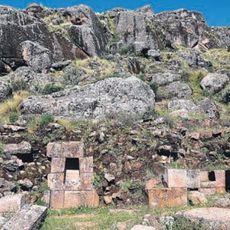
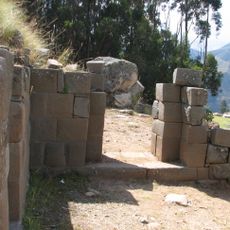
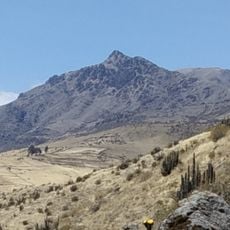
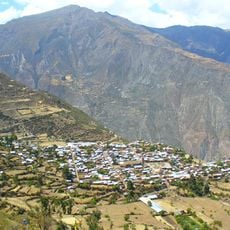
Marayniyuq, Archaeological site in Huanta, Peru.
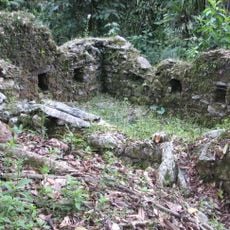
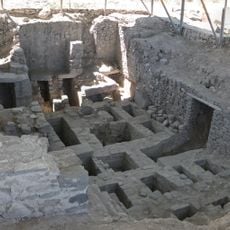
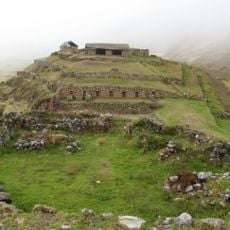
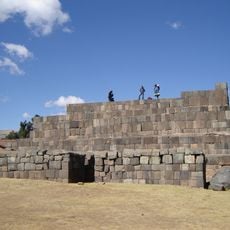
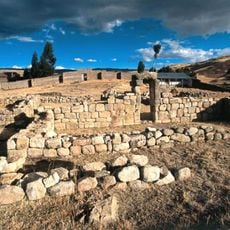
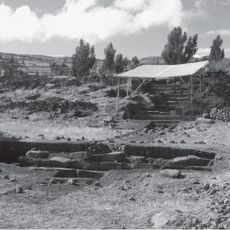
Marayniyuq is a Wari archaeological site on the Vega Pampa plain, about 4 km north of Huari and southeast of Huanta, on the border of Huanta and Huamanga provinces. Its partly excavated main building covers almost 200 square metres, with two successive diatomite floors; fragments of Middle Horizon pottery (600–900 CE) lie scattered over a wide area, and Huarpa-style ceramics appear at the northern end.
Marayniyuq lies in Vega Pampa, about 4 km north of Huari. In 1998, earth removal there exposed large stone blocks, and archaeologists Lidio Valdez, Ernesto Valdez and Katrina Bettcher then began long-term survey work. The site is attributed to the Wari culture; Huarpa pottery of the Early Intermediate Period (200 BCE–600 CE) appears at its northern end, and Middle Horizon sherds (600–900 CE) lie scattered over a wide area.
The name Marayniyuq comes from Quechua maray, a grindstone, with the suffixes -ni and -yuq. Excavations suggest the site was used for grinding maize and making chicha. The ground floor of the excavated building rests on a base of gravel and stones, with walls to the north and east.
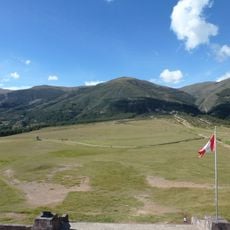
Marayniyuq lies in the plain of Vega Pampa, about 4 km north of Huari and southeast of Huanta. It can be reached from both Huanta and Ayacucho on the road linking the two cities; the branch road to Huamanguilla turns off at Vega Pampa and cuts through part of the site. Portions of walls and Middle Horizon pottery are visible in the surrounding fields.
The name Marayniyuq comes from Quechua maray, a grindstone, with the suffixes -ni and -yuq. Excavations of a building of nearly 200 square metres found two successive diatomite floors, the lower laid over gravel and stones, suggesting the place was used to grind maize and brew chicha.
The community of curious travelers
AroundUs brings together thousands of curated places, local tips, and hidden gems, enriched daily by 92,632 contributors worldwide.