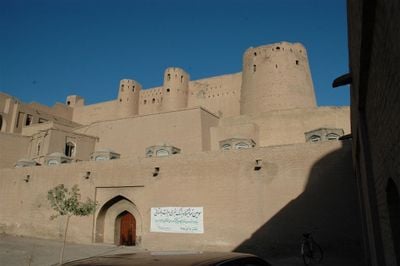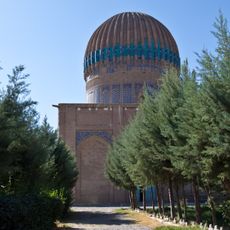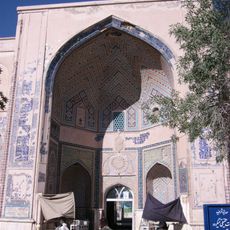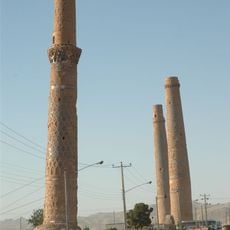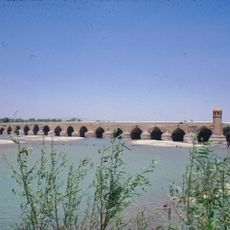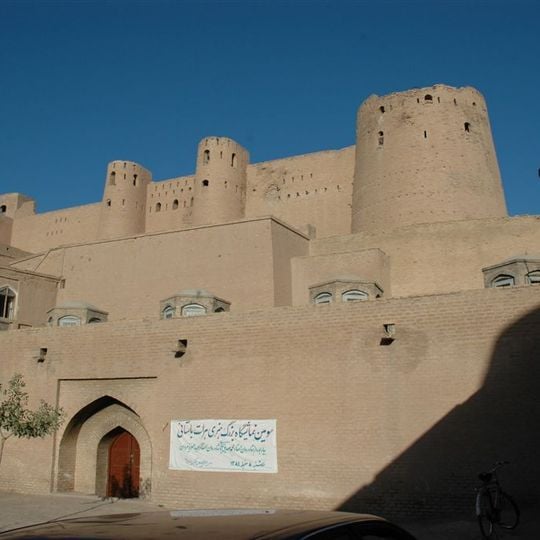
Herat Citadel, Castle in Herat, Afghanistan.
The Herat Citadel is a military fortress in Afghanistan with thick defensive walls and tall towers that rise prominently above the city. The structure houses a museum displaying regional collections and opens its inner grounds to visitors.
The site is linked to fortifications built after Alexander the Great reached the Hari Rud region around 330 BC, though the present structure dates from later periods. After the Mongol destruction of Herat in the 13th century, the Kart rulers rebuilt it, notably Fakhr al-Din Kart around 1300, adding towers, walls and a moat. Timur damaged it in 1381; Shah Rukh rebuilt it in stone and brick in 1415–1416, decorating the towers with glazed tiles.
The citadel's name Ikhtiyaruddin appears in sources from the early 14th century; scholars disagree whether it came from a Kart military commander or was a title for the fortress itself. Local Herati tradition credits a legendary woman, Shamira or Shamiran, with organizing the first strong wall to free the people from tribute demands. The Herat National Museum inside holds about 1,100 items from the region, many on display.
The grounds require time to explore properly since there are multiple areas and stairs leading to the towers. Visitors should wear sturdy footwear and be prepared for uneven surfaces and changes in elevation.
The citadel's name Ikhtiyaruddin appears in sources from the early 14th century; scholars disagree on whether it came from a Kartid military commander or was a title for the fortress itself. Local Herati tradition credits a legendary woman, Shamira or Shamiran, with ordering the first strong wall built to free the people from tribute demands.
The community of curious travelers
AroundUs brings together thousands of curated places, local tips, and hidden gems, enriched daily by 92,638 contributors worldwide.