Malan bridge, Ancient arch bridge in Herat Province, Afghanistan.
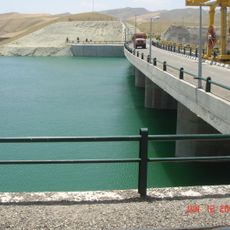
Malan Bridge, also called Pul-i-Malan, is a two-lane arched bridge over the Hari River linking Injil District with Guzara District in Herat Province. It is 230 m long, 8 m wide and 10 m high, and now carries 22 arches; two towers stand at its northern approach. The Danish Committee for Aid to Afghan Refugees rebuilt it in concrete and baked bricks, reopening it in 1995.
Built in 1110–1112 under the Seljuk sultan Ahmad Sanjar, the bridge was described by the 15th-century historian Khondemir. Spring floods damaged it, and the Mughal emperor Babur had it restored in 1506. It carried the only road between Herat and Kandahar until a modern bridge was built upstream in 1961–62. Two guard towers and five arches were destroyed during the Soviet–Afghan War, and the Danish Committee for Aid to Afghan Refugees rebuilt it, reopening it in 1995.
The name Pul-i-Malan means "Bridge of Goods", recalling the caravan route between Iran and India that crossed here. Legend credits two Zoroastrian sisters, Bibi Nur and Bibi Hur, with building it around AD 900, mixing eggshells into clay to make a material stronger than steel.
Malan Bridge lies about 12 km south of Herat's old city on the road toward Kandahar, downstream from Pul-i Pushtu. Since 1961–62 the modern highway crosses the Hari River on the newer Pul-i Pushtu bridge, so the historic span now carries local traffic between Injil and Guzara districts. It is a two-lane crossing, 8 m wide, with two towers at its northern approach.
The bridge's name means "Bridge of Goods" in Dari, a trace of its role on the caravan route between Iran and India. The 15th-century historian Khondemir described it, and the Yellow Cruise expedition crossed it in 1931. Two towers stand at its northern approach.
The community of curious travelers
AroundUs brings together thousands of curated places, local tips, and hidden gems, enriched daily by 92,604 contributors worldwide.