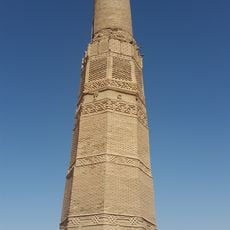
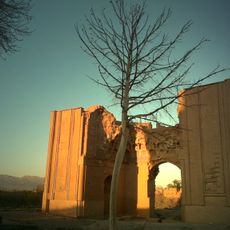
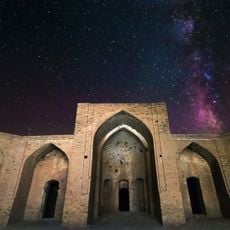
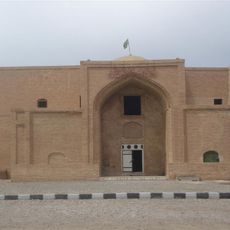
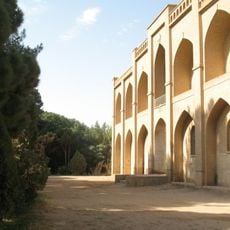
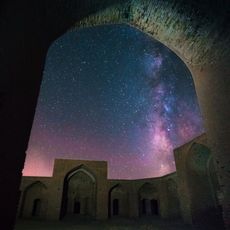
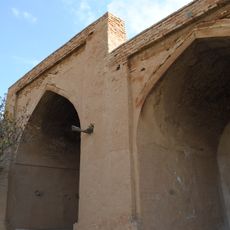
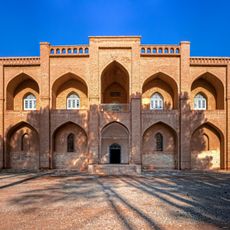
Khwaja 'Abd Allah Ansari shrine, Timurid mausoleum and sanctuary in Gazurgah Village, Herat, Afghanistan.
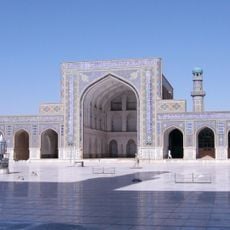
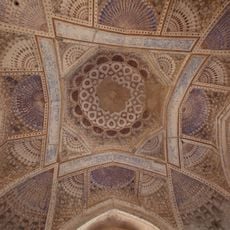
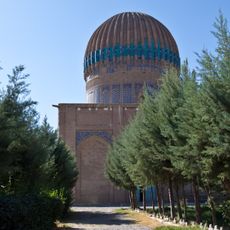
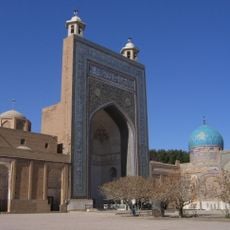
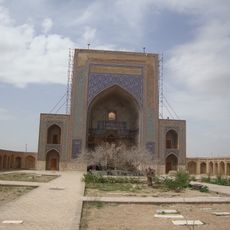
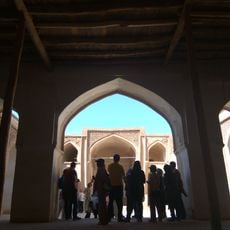
Khwaja 'Abd Allah Ansari shrine is the funerary complex at Gazur Gah, about 3 km northeast of Herat, Afghanistan. Its west-facing portal is semi-domed and five-sided, with glazed turquoise and black banai brickwork laid in a chevron pattern. Behind it lie an octagonal dihliz, a five-section masjid with plaster muqarnas ceilings, a Jamaat Khana and a courtyard enclosed by two long facades.
The shrine was built in 1425 by the architect Qavam al-Din of Shiraz for the Timurid ruler Shah Rukh, as a memorial mausoleum for the Sufi mystic and patron saint of Herat, Khwaja Abdullah Ansari. Construction took about three years, and the ornamentation was likely designed by Qavam al-Din himself and executed by a team of mosaicists. The Afghan ruler Dost Mohammad Khan, who died on 9 June 1863 after taking Herat, was buried here.
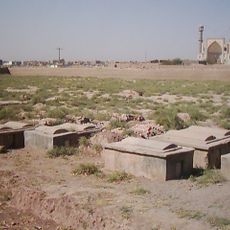
The site is named Gazur Gah after the village where Khwaja Abdullah Ansari, a Persian-language Sufi mystic and patron saint of Herat, is buried. His tomb is surmounted by trees, and a tall marble column and headstone stand north of it in his honour. The graveyard around him held princes, dervishes, state officials, soldiers and poets, their tombs set with stones of every colour and size.
The site is best explored on foot, with visitors able to easily navigate the various entrances and interior spaces. It is advisable to wear appropriate clothing and be respectful of local customs, especially when religious activities are taking place.
The east iwan's walls are left rough while its facade carries intricate mosaic, likely because the whole complex went up in about three years, roughly the time usually given to decoration alone. This suggests Qavam al-Din designed the ornament himself and a team of mosaicists executed it.
The community of curious travelers
AroundUs brings together thousands of curated places, local tips, and hidden gems, enriched daily by 92,618 contributors worldwide.