Lezhë Castle, Medieval fortress on hilltop near Drin River, Albania
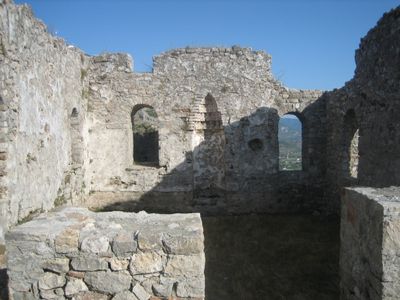
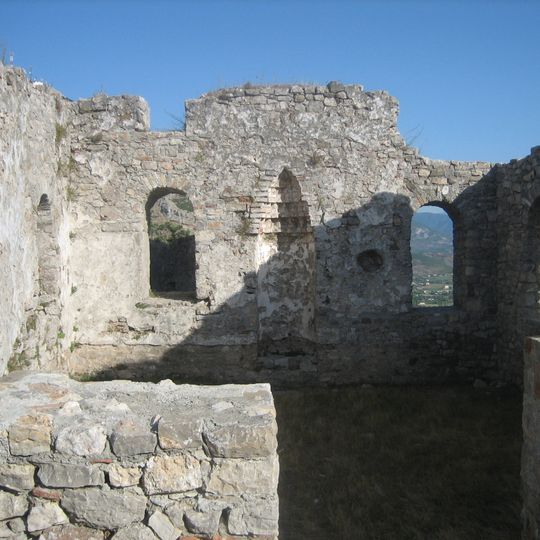
Lezhë Castle is a stone fortress on a 186-metre hill east of Lezhë, its walls built of roughly cut grey and beige blocks in pale mortar. The ruin rises in an uneven line pierced by four arched openings: two tall narrow round-arched windows in the centre, a small round opening high on the left and a wider arch on the right. A low rough stone wall stands in the foreground.
Lezhë Castle began as an Illyrian fortification above the city; the name Lissus appears in Diodorus in connection with Dionysius I of Syracuse, who founded a colony there. The first reconstruction of the walls dates to the 1st century BC, and in the 11th–12th centuries a medieval castle, Elission, was built on the acropolis with small dressed stones and mortar. The Venetians rebuilt it in 1440, the Ottomans after 1522, and a 1979 earthquake caused serious damage before restoration work in 2002.
The name Lissus appears in Diodorus's account of Dionysius I of Syracuse founding a colony on the Adriatic, and the hill later held the assembly of 1444 led by Gjergj Kastriot Skënderbeu. Inside the walls stand the ruins of Ottoman buildings and a mosque, and the Church of Saint Nicholas from the 14th century is a historic monument nearby.
The castle stands on a hill east of Lezhë, at 186 metres above sea level; the climb is steep, so wear sturdy shoes. Three gates pierce the walls, the first two on the lines of the ancient city gates of Lissus. Restoration and conservation work carried out from August 2002 consolidated the walls after serious damage from the 1979 earthquake.
The fortress displays an unusual mix of building materials and styles left behind by four different civilizations over time. A careful visitor can still see the different stone types and construction techniques layered together across the centuries.
The community of curious travelers
AroundUs brings together thousands of curated places, local tips, and hidden gems, enriched daily by 94,090 contributors worldwide.