Arin-Berd, Archaeological site and hill in Yerevan, Armenia.
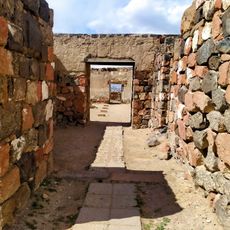
Arin-Berd is a hill on Yerevan's southeastern edge where the Urartian city of Erebuni was built in 782 BC. Excavations from 1950 to 1968 uncovered about 100 rooms of the citadel, including a hall measuring 12.5 by 39 metres, two inner courtyards and the temples of Khaldi and Ausi, all enclosed by a thick fortress wall.
Arin-Berd was founded in 782 BC by the Urartian king Argishti I, son of Menua, as a fortified city guarding the kingdom's northern border. A cuneiform stone found at the hill's foot in 1879 records his grain store of 10,100 kapi. Excavations from 1950 uncovered about 100 rooms, the palace with the temple of the god Khaldi, and later Achaemenid rebuilding.
The hill's Armenian name, Arin-Berd, means "Blood Fortress"; researchers link "fortress" to Erebuni and "blood" to the red poppies that grew on the abandoned site for centuries. Excavations found cylinder seals, agate and carnelian beads, bronze arrowheads, and silver coins from Miletus and Achaemenid rhytons.
The hill rises on Yerevan's south-eastern edge in the Erebuni district, and the excavated rooms, courtyards and fortress walls lie on its summit. Paths are uneven and partly stepped, so wear sturdy shoes. Much of the site is open ground with little shade, making morning visits cooler.
The hill's name means "Bloody Fortress", though no violent event is recorded there; red poppies are thought to have grown on the abandoned site for centuries. Excavations in 1950–1968 uncovered about 100 rooms of the citadel, including a hall measuring 12.5 by 39 metres with five columns along its long axis.
The community of curious travelers
AroundUs brings together thousands of curated places, local tips, and hidden gems, enriched daily by 92,643 contributors worldwide.