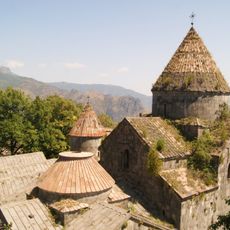
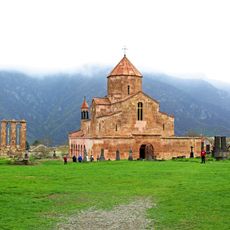
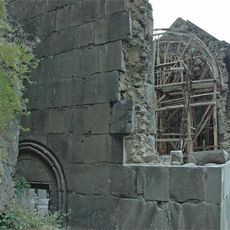
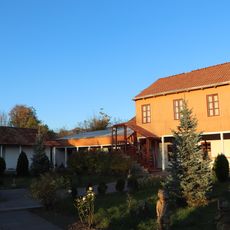
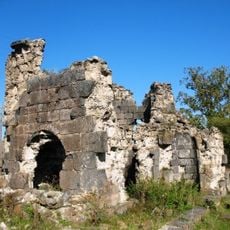
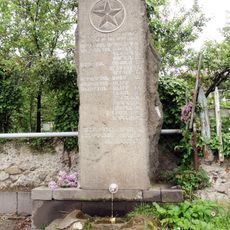
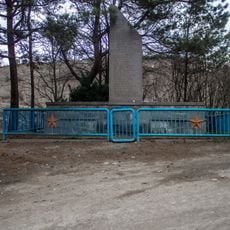
Lusavorich church, Dsegh, Religious monument in Dsegh, Armenia.
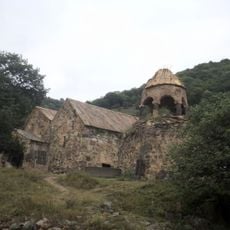
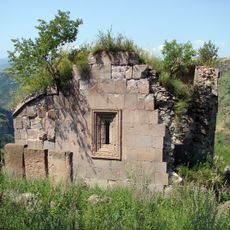
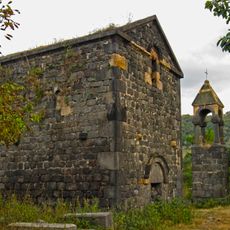
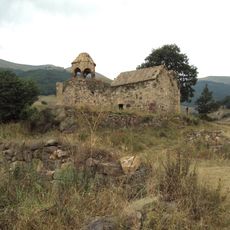
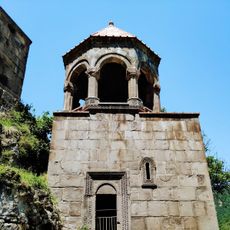
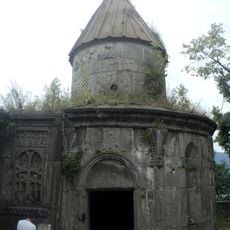
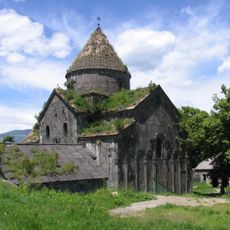
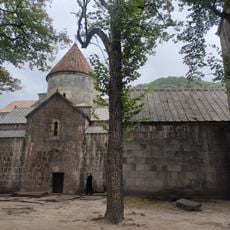
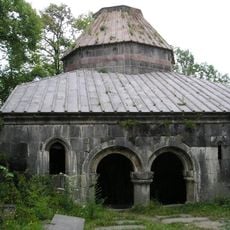
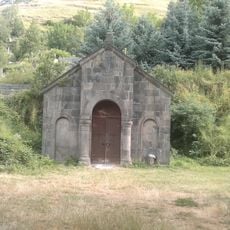
Lusavorich Church is a rectangular hall church with an apse projecting beyond the eastern wall and two side chambers; the southern chamber was rebuilt in the 10th century as a belfry of yellowish-red felsite. The church stands in Dsegh's central medieval cemetery, next to Hovhannes Tumanyan's house-museum, enclosed by a low stone wall.
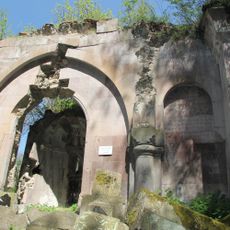
The church was built in the 7th century in the centre of Dsegh, on the site of a medieval cemetery beside Hovhannes Tumanyan's house-museum. Almost nothing of the original structure survives; the present rectangular hall with an east apse results from a reconstruction completed in 1900, recorded in an inscription on the apse's front arch. Further restoration followed in 1969.
The church stands inside a medieval cemetery in the centre of Dsegh, beside Hovhannes Tumanyan's house-museum, enclosed by a low stone wall. The south aisle was rebuilt in the 10th century by the Mamikonian princes as a belfry of yellowish-red felsite, and its east facade keeps the family coat of arms: a double-headed eagle holding a lamb in its claws.
The church is maintained under the protection of the Diocese of Gougark, making it accessible to visitors who approach it with respect for its religious purpose. Sturdy footwear is advisable since the path to the church involves walking through unpaved village roads.
The south annex was rebuilt in the 10th century as a belfry by the Mamikonian princes, using yellowish-red felsite. On its east facade survives the family coat of arms: a double-headed eagle holding a lamb in its claws. A sundial is carved on the south wall.
The community of curious travelers
AroundUs brings together thousands of curated places, local tips, and hidden gems, enriched daily by 94,334 contributors worldwide.