Lori Berd Fortress, Medieval fortress in Lori Province, Armenia.
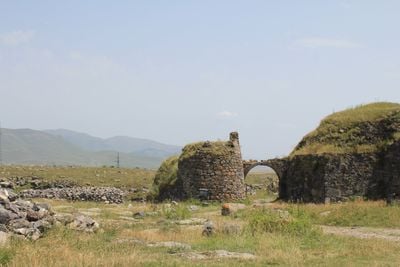
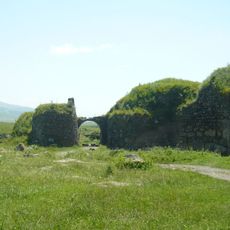
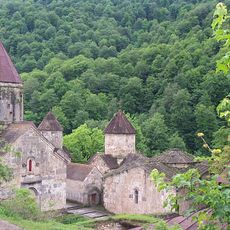
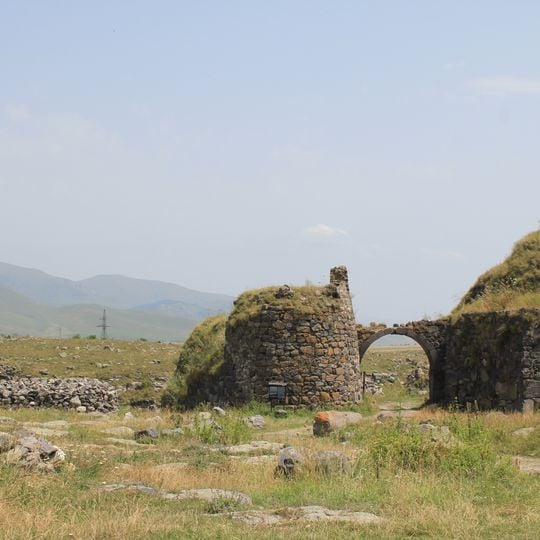
Lori Berd is a medieval fortress on a triangular plateau at 1,490 m between the Dzoraget and Urut gorges, 4.5 km from Stepanavan. Its northwest side is closed by a 214 m wall with alternating round and rectangular towers, up to 20 m thick and 20–25 m high, and a single gate. The main photo shows two rough stone towers flanking an arched gateway, with a ruined wall to the left.
Founded by David Anhoghin around 1005–1020, Lori became the capital of the Kyurikid kingdom in 1065 under Kyurike II. It was a major trade and craft centre on the northern route, with about 10,000 inhabitants in the 11th–13th centuries. In June 1236 the Mongol army led by Chaghatai Nu'in captured and destroyed the city.
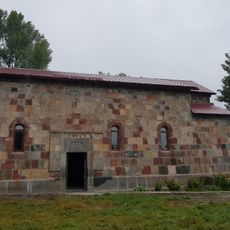
The excavated rectangular building with a mihrab stone set into its southern wall was a Muslim mosque of the 14th–15th centuries, its interior divided into six parts under domes on spherical pendentives. Excavations also uncovered a house whose wall paintings are secular in subject, unlike other monuments of the period. The site is studied by a Yerevan State University expedition since 1966.
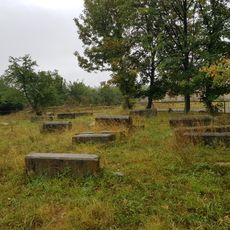
The site covers 35 hectares on a plateau 1,490 m above sea level between the Dzoraget and Urut gorges, which make it inaccessible on three sides. The only entrance lies at the northwest corner of the 214 m wall, where round and rectangular towers follow one another. Excavations by Yerevan State University have run here since 1966, so some trenches and structures may be fenced off.
Archaeological findings suggest the fortress once supported thousands of residents and featured a sophisticated bathhouse system with heating mechanisms and clay pipes for water distribution. These details reveal an impressive level of comfort and urban planning for its medieval period.
The community of curious travelers
AroundUs brings together thousands of curated places, local tips, and hidden gems, enriched daily by 92,846 contributors worldwide.