Pointe Vénus Lighthouse, Lighthouse in Mahina, Tahiti, French Polynesia
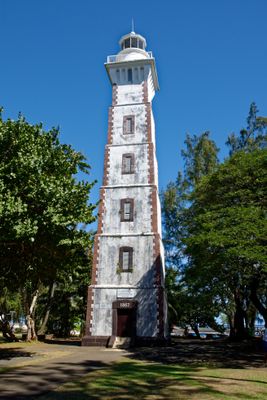
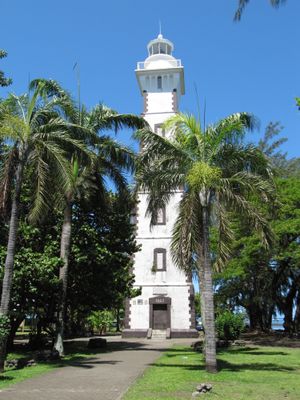
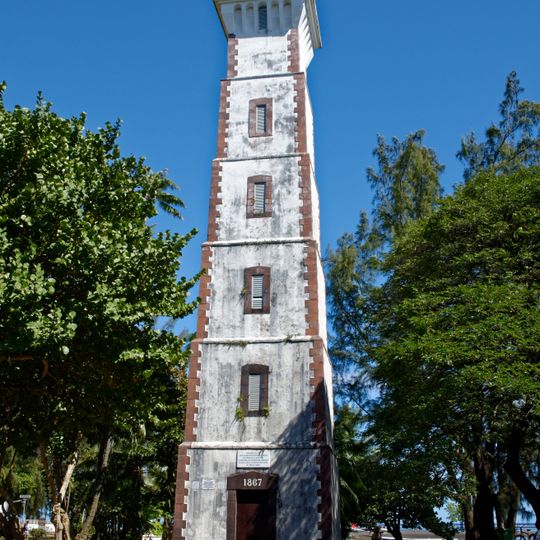
Pointe Vénus Lighthouse is a square, eight-storey tower of rubble and coral, 25 metres tall, in Mahina at the northern tip of Tahiti. Its white walls are weathered with grey streaks, and the corners of each level carry alternating red and white blocks. Four windows with closed white louvred shutters run up the front, and a plaque above the dark doorway reads "1867". A wider open structure with vertical slats tops the tower.
A lantern was placed on the site in 1856, and the lighthouse itself was built in 1867 by Mangarevian workers, first lit on 1 January 1868 with a fixed white light visible at 15 miles. It was the first lighthouse in the South Pacific and remains the only one in Tahiti. In 1953 it was raised by nine metres, and in 1973 it received an electric light.
Locals call the site Teara o Tahiti or Tepaina venuti, names carried alongside the French one. The headland takes its name from James Cook's 1770 observatory, built to track the planet Venus; Bougainville and Wallis had landed there earlier. The lighthouse was built in 1867 by Mangarevian workers and first lit on 1 January 1868.
The lighthouse stands at the end of the road at Pointe Vénus, in Mahina commune on Tahiti's north coast, within a public coastal area with a beach and lawns. Visitors reach the tower on foot from the car park; the interior is not open for climbing. The site is also used for aerial navigation, so the lantern and lenses remain in service.
During World War II, locals painted coconut palm designs on the lighthouse to hide it from Japanese aircraft. This creative defense attempt shows the resourcefulness of island residents during wartime.
The community of curious travelers
AroundUs brings together thousands of curated places, local tips, and hidden gems, enriched daily by 92,612 contributors worldwide.