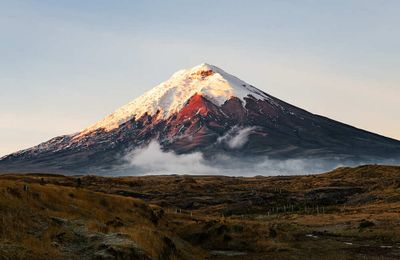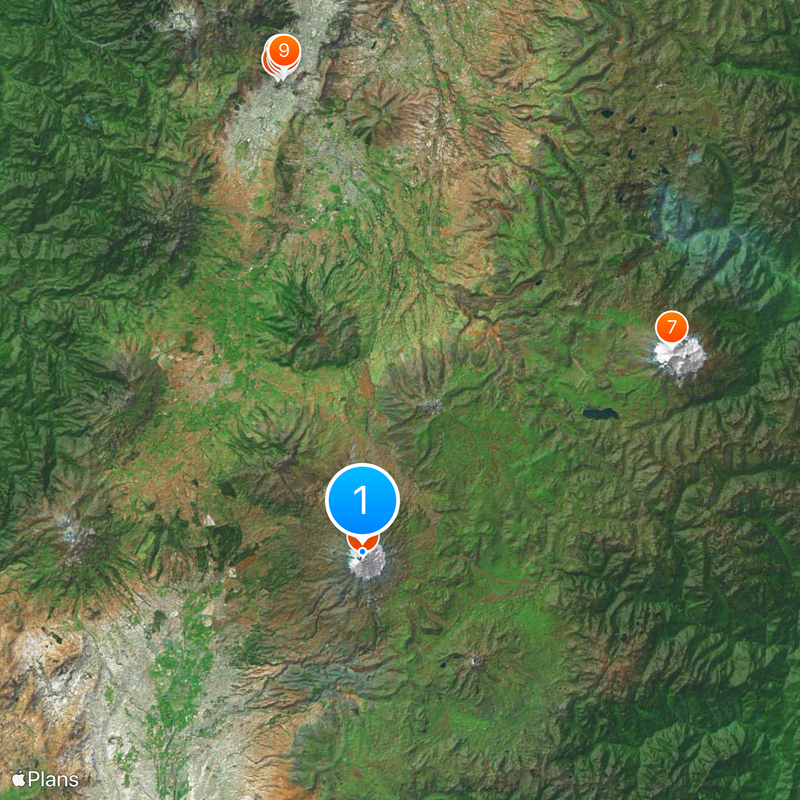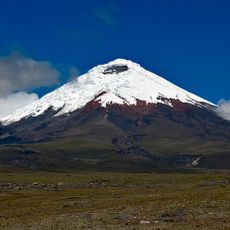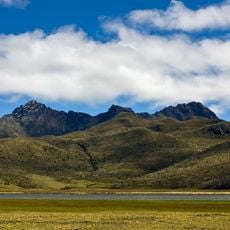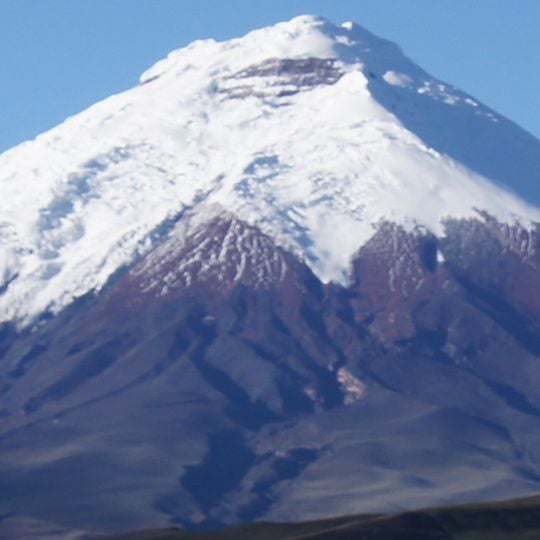
Cotopaxi volcano, Active stratovolcano in Cotopaxi National Park, Cotopaxi Province, Ecuador
Cotopaxi is an active stratovolcano in Cotopaxi Province, Ecuador, rising to an altitude of 5,897 meters with a nearly symmetrical cone towering over a highland plain. The mountain's flanks climb from around 3,800 meters to the glacier-capped summit, with tuff forming much of the volcanic structure.
In 1877, a major eruption produced pyroclastic flows and lahars that traveled more than 100 kilometers, reaching both the Pacific Ocean and the Amazon basin. Since then, several smaller eruptions have occurred, demonstrating that the volcano remains geologically active.
Quechua speakers explain the name as q'oto ('throat') plus Aymara phakhsi ('moon'), referring to the crescent-shaped crater. Before the Inca arrived in the 15th century, Andean peoples honoured Cotopaxi as a sacred mountain and rain sender that guaranteed the land's fertility, and revered its summit as a dwelling of gods.
The José F. Ribas refuge at 4,864 meters (15,958 feet) serves as a shelter and acclimatization point for climbers heading to the summit. Weather conditions change quickly at this altitude, so visitors should be prepared for shifting temperatures and sudden fog.
The summit holds one of the few equatorial glaciers in the world, with ice beginning at 5,000 meters (16,404 feet) and persisting year-round. Meltwater from this glacier feeds rivers that drain into both the Pacific Ocean and the Amazon basin.
The community of curious travelers
AroundUs brings together thousands of curated places, local tips, and hidden gems, enriched daily by 92,453 contributors worldwide.