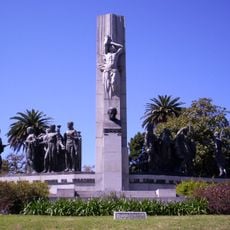
Holocaust Memorial, Montevideo, War memorial in Punta Carretas, Uruguay.
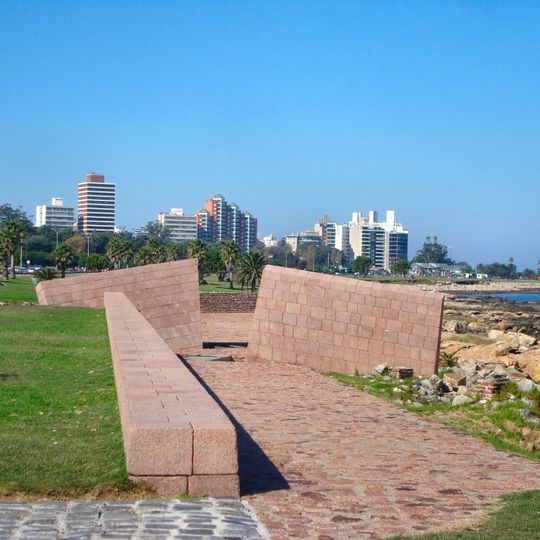
The Holocaust Memorial in Montevideo stretches 120 meters along the Rambla shoreline and is built from pink granite with a central window opening toward the water. The structure incorporates railroad tracks and wooden bridge elements as integral architectural features.
In 1992 the Intendencia de Montevideo held a competition for a Holocaust memorial; the first prize went to Uruguayan architects Gastón Boero, Fernando Fabiano and Sylvia Perossio, with landscaping by Carlos Pellegrino, and the work opened in 1994. It was declared a National Historic Monument and represented Uruguay at the 1995 World Architecture Biennial. After antisemitic graffiti, it was cleaned and rededicated in June 2016, with lights and staircases added, funded by the Central Israelite Committee; it was vandalized again a year later.
The memorial's route begins on a descending stone ramp cut between exposed natural rock, passes through two narrow wooden bridges at its lowest point, and opens onto a plaza with three slabs engraved with biblical texts and writings by Jewish thinkers. A stele bears a dedication signed by Elie Wiesel. The pink granite wall runs parallel to the river along the Rambla.
The memorial sits along Rambla Presidente Wilson and is easy to access from the waterfront promenade. Plan time to move through the space slowly and explore the different structural elements without rushing.
The memorial's stele include one signed by Elie Wiesel, the Holocaust survivor and Nobel Peace Prize laureate. The monument was chosen to represent Uruguay at the 1995 World Architecture Biennial and was later shown at the Museum of Modern Art in New York. In 1998 the Mies van der Rohe Foundation of Barcelona listed it among the best Latin American works.
The community of curious travelers
AroundUs brings together thousands of curated places, local tips, and hidden gems, enriched daily by 94,703 contributors worldwide.