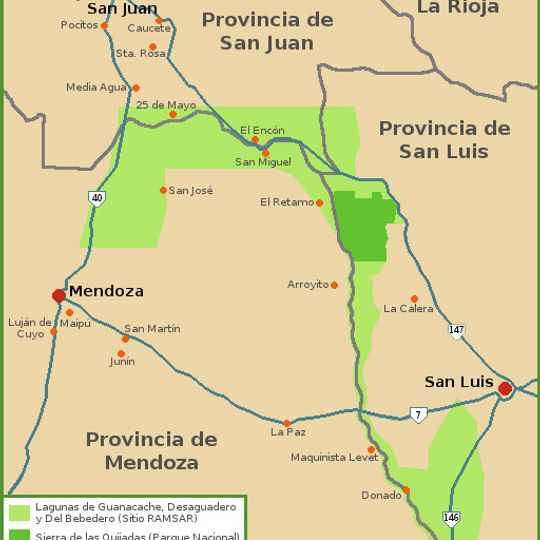
Lagunas de Guanacache, Desaguadero y del Bebedero, Interconnected lagoon system in central-western Argentina.
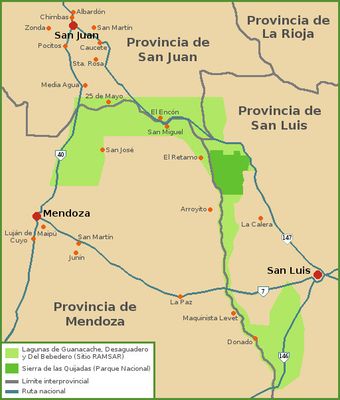
The Lagunas de Guanacache, Desaguadero y del Bebedero form an interconnected network of freshwater lakes and marshes spread across Mendoza, San Juan, and San Luis provinces. The system receives water from two major rivers and functions as a natural water storage and drainage network for the region.
The Huarpe people settled the lagoon shores from around the 6th century, fishing and navigating the shallow water. Spanish encomiendas depopulated the area from the 16th century. Large dams built upstream on the Mendoza and San Juan rivers in the early 20th century cut the water supply and drove out nearly all remaining inhabitants. The site was designated a Ramsar wetland on 14 December 1999 (580,000 ha) and enlarged on 5 June 2007 to 962,370 ha with San Luis and Sierra de las Quijadas National Park.
The Huarpe settled the lagoon shores from around the 6th century, fishing and navigating the water in reed boats likened to the caballitos de totora of Lake Titicaca. Spanish encomiendas depopulated the area, and the great dams of the 20th century drove out nearly all remaining inhabitants. Today about 4,000 people identify as Huarpe "laguneros".
The lagoons are located in a dry region where infrastructure is limited, so visiting requires some preparation and planning. It helps to work with local guides who know the terrain and can point out the best spots for observing wildlife and water features.
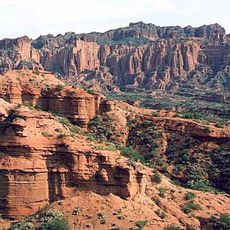
The site's Ramsar listing began in 1999 with 580,000 hectares in Mendoza and San Juan; on 5 June 2007 it was enlarged to 962,370 hectares after San Luis joined, taking its present name. The Sierra de las Quijadas National Park and the Salinas del Bebedero lie within the protected area.
The community of curious travelers
AroundUs brings together thousands of curated places, local tips, and hidden gems, enriched daily by 92,637 contributors worldwide.