Port of Paranaguá, Maritime trade center in Paranaguá, Brazil.
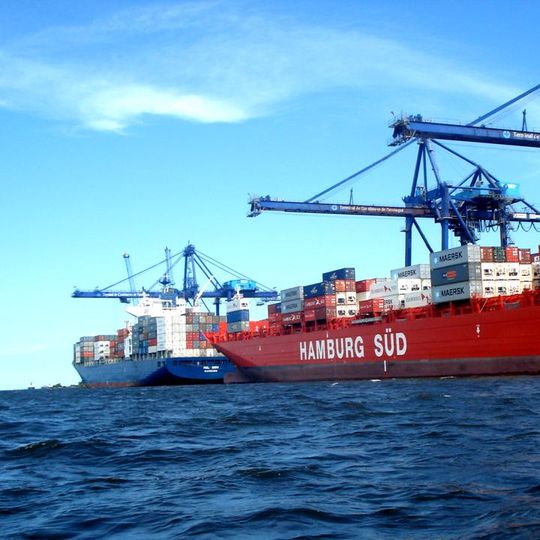
The Port of Paranaguá, also called Porto Dom Pedro II, lies on the coast of Paraná and is the largest bulk port in Latin America. Its terminals handle soybeans, soybean meal, corn, fertilizers, containers, liquids, automobiles, wood, paper, salt and sugar. Container ships such as Hamburg Süd and Maersk vessels dock beneath tall blue steel cranes whose arms extend over the water.
The port began in 1872 as a privately owned wharf. In 1917 the state of Paraná took over its concession and expanded it; the new port opened in 1935, handling 91,500 tons in its first year. The Administração dos Portos de Paranaguá was created in 1947 and, from 1971, also managed Antonina as APPA.
The port's name honours Dom Pedro II, and its nickname in Paranaguá is simply "o porto". Its cranes and berths handle soybeans, soybean meal, corn, fertilizers and containers, and the ships arriving from abroad come mostly from the United States, China, Japan and South Korea. The container terminal is the only one in southern Brazil with direct rail access.
Road access runs via the BR-277, PR-401, PR-411, PR-410 and PR-412 highways, and the Sul-Atlântico railway reaches the container terminal directly. The main waterway is the Galheta channel, 28.5 km long, 150 to 200 m wide and 12 m deep. The port is open to tourists, students and businesspeople; expect heavy truck traffic in the city.
The port has direct rail access to its container terminals, setting it apart from other ports in the region. This infrastructure allows efficient cargo movement and significantly contributes to its operations.
The community of curious travelers
AroundUs brings together thousands of curated places, local tips, and hidden gems, enriched daily by 94,256 contributors worldwide.