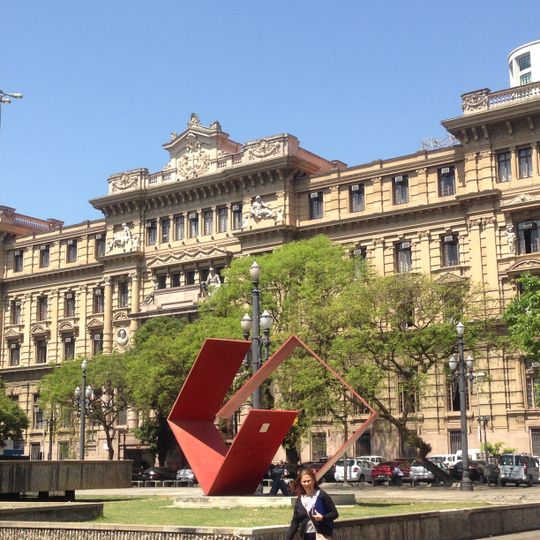
Palácio da Justiça, Courthouse in Glicério, São Paulo, Brazil
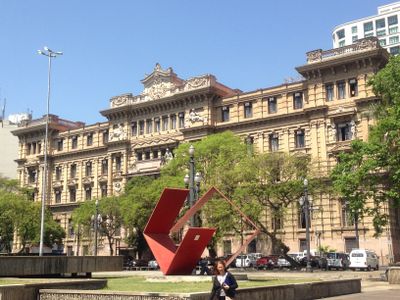
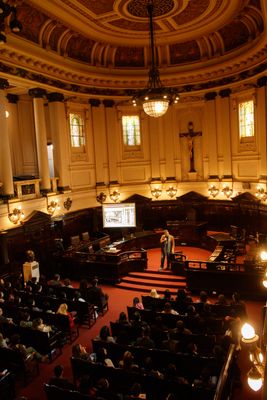
The Palácio da Justiça is a Neoclassical courthouse with a pale yellow stone facade and a dark roof, its central section rising above the wings under a pediment and roof cresting. Rows of tall rectangular windows framed by pilasters and cornices alternate with sculpted figures and relief panels, and balustraded balconies run along the upper level. Inside, a tall hall with a curved rear wall is arranged in tiers, with a dark wood-panelled bench and a raised dais fronted by a curving red-carpeted staircase.
The idea for a new courthouse was raised in 1911 by Justice Secretary Washington Luís, and the office of architect Ramos de Azevedo was hired that year, modeling the design on Rome's Palazzo di Giustizia. The cornerstone was laid on 24 August 1920 on the site of an old cavalry barracks. Work stalled during the 1924 São Paulo Revolt and after Ramos de Azevedo died in 1928, when Ricardo Severo and Arnaldo Dumont Vilares took over. The palace opened on 2 January 1933 and was reinaugurated in 1942 for the city's 388th anniversary.
The building's nickname, "unfinished symphony", came from the long delay in its construction, which the public doubted would ever end. Its eclectic interior combines baroque and neoclassical elements, with panels, stained glass, murals and paintings, plus caryatids and symbols of the judiciary on the facade. The inauguration session on 2 January 1933 heard a speech by Minister Urbano Marcondes de Moura.
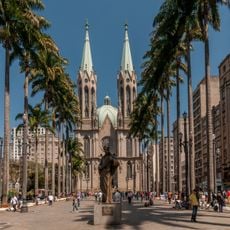
The palace sits between Praça da Sé, Praça João Mendes Jr. and Praça Clóvis Bevilácqua, near the cathedral and the Anchieta and Matarazzo palaces. The courtrooms of the appellate level and the judiciary's administrative offices still operate inside, so access to the interior depends on the court's visiting arrangements rather than fixed public hours.
The building was one of the first in Brazil to use metal structures, which allowed the large interior spans. Its facade took inspiration from Rome's Palazzo di Giustizia, and the ornament includes caryatids and symbols of the judiciary. Construction delays earned it the nickname "unfinished symphony".
The community of curious travelers
AroundUs brings together thousands of curated places, local tips, and hidden gems, enriched daily by 92,813 contributors worldwide.