Municipal Theater of São Paulo, Opera house in Central Zone, São Paulo, Brazil
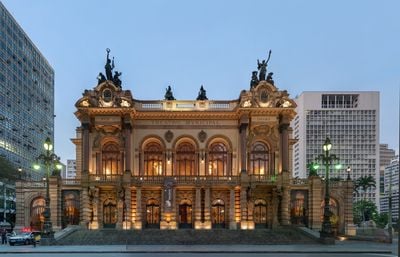
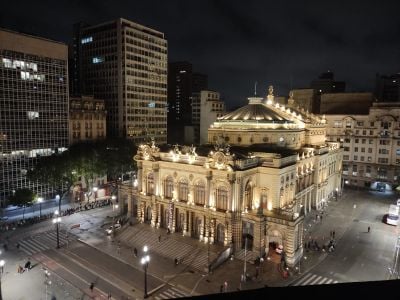
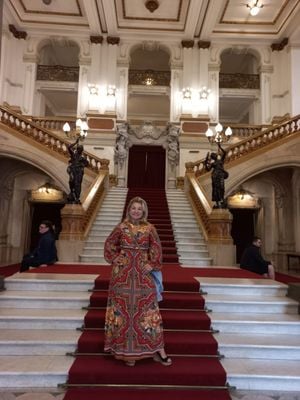
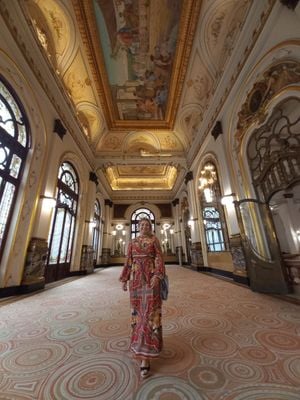
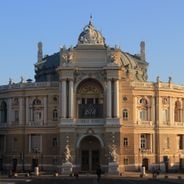
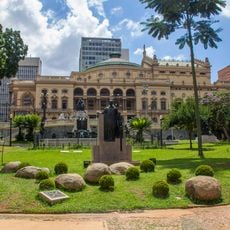
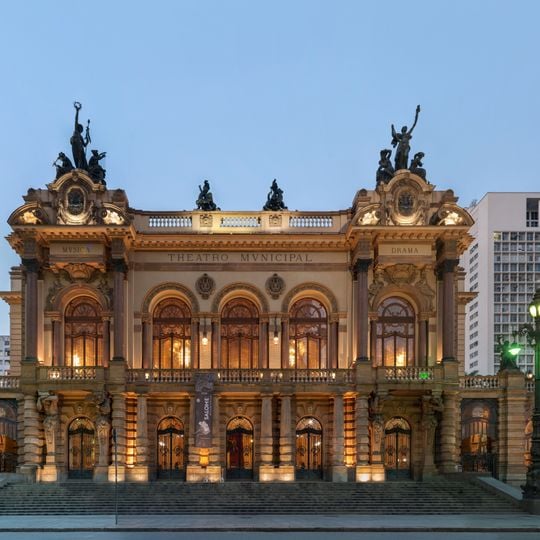
The Municipal Theater of São Paulo is an eclectic opera house on Praça Ramos de Azevedo, modeled on the Palais Garnier in Paris. Its pale stone facade has six square columns and five arched doorways below a balcony; three bronze statues stand on the top balustrade, and a carved band reads "THEATRO MUNICIPAL", flanked by panels marked "MUSICA" and "DRAMA". A ribbed dome with a lantern rises over the auditorium, and the interior is divided into four bodies: foyer and grand staircase, auditorium, stage, and dressing rooms.
Construction began on 26 June 1903 under engineer Ramos de Azevedo, with designs by Claudio and Domiziano Rossi, and lasted about eight years. The opening on 12 September 1911 staged Ambroise Thomas's opera Hamlet, chosen because baritone Titta Ruffo preferred the title role to anything by Carlos Gomes. Around 20,000 people gathered to see the electric lighting of the new building.
The theatre hosted the Semana de Arte Moderna from 11 to 18 February 1922, with an exhibition and, on the evenings of 13, 15 and 17 February, concerts, poetry readings and lectures. Mário de Andrade, Oswald de Andrade, Anita Malfatti, Di Cavalcanti and Heitor Villa-Lobos took part. The event is taken as the starting point of Brazilian Modernism.
The theatre stands on Praça Ramos de Azevedo, at the foot of the Morro do Chá, with the entrance reached by a broad stone staircase. The 1,523-seat auditorium has columns and side seats with partial views of the stage. Guided tours cover the foyer and the performance hall.
The theatre's first staged production, on 12 September 1911, was Ambroise Thomas's opera Hamlet, not a Shakespeare play. Baritone Titta Ruffo, expected in Il Guarany, had no Gomes role in his repertoire and proposed Hamlet as his favourite part instead.
The community of curious travelers
AroundUs brings together thousands of curated places, local tips, and hidden gems, enriched daily by 92,700 contributors worldwide.