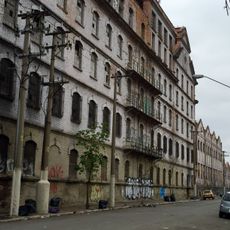
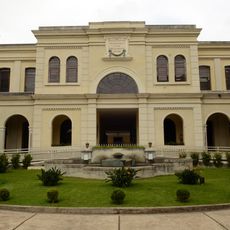
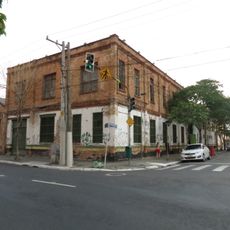
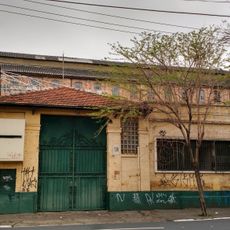
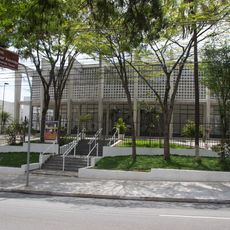
Edifícios industriais da Rua Borges de Figueiredo, Industrial complex in Mooca District, São Paulo, Brazil.
The Edifícios industriais da Rua Borges de Figueiredo occupy 24,284 m² along Rua Borges de Figueiredo, with warehouses set diagonally to the old railway line, now the Juventus-Mooca station. The brick and reinforced-concrete sheds have wooden roofs covered in ceramic tiles, partly replaced by fibre-cement sheets. The Duchen biscuit factory sheds also use metal trusses and skylights.
In 1906 the Francisco Matarazzo company occupied the site at Rua Borges de Figueiredo 680–828, sharing it with the Fiat Lux match factory, built the same year. In 1908 the French firm Societé Anonyme Anciens Établissements Duchen acquired part of the land for a biscuit factory. The complex, built between 1906 and 1926 to designs attributed to Otto Nilsson and Fred Reimann, also served as a warehouse and possibly an oil plant.
The complex's name links three firms: the Matarazzo industries, the Fiat Lux match factory and the Duchen biscuit factory. The Mooca neighbourhood grew around the São Paulo Railway line laid beside the warehouses, and the sheds, set diagonally to the tracks near today's Juventus-Mooca station, are what gave the district its industrial character.
The complex is owned and operated by CBL (Companhia Brasileira de Latas), which makes tin cans on site, so the sheds are working premises and not open to visitors. The warehouses stand at a diagonal to the old São Paulo Railway line, beside today's Juventus-Mooca station; the Fiat Lux chimney can be seen from the boundary with the Eletropaulo transmission strip.
The old chimney from the Fiat Lux match factory still stands today and is the last surviving example of this type of industrial structure in the city. Its presence recalls how differently factories looked and operated in that era.
The community of curious travelers
AroundUs brings together thousands of curated places, local tips, and hidden gems, enriched daily by 93,804 contributors worldwide.