Castanhão Dam, Water management facility in Jaguaribara, Brazil.
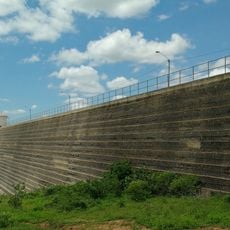
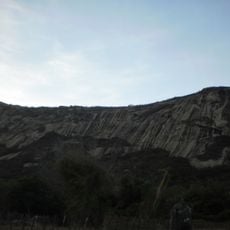
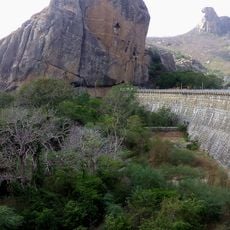
Castanhão Dam is a 1,500-metre-long embankment dam across the Jaguaribe River in Ceará, with a crest 11 metres wide, 12 floodgates and four dispersing valves. Its upstream face is a broad slope of gray rock and earth; at the right end a tall, smooth concrete wall curves inward against the water, with a small concrete tower at its outer corner. Behind the crest, a concrete spillway channel with repeated vertical piers runs down toward the reservoir.
Studies for a reservoir at Boqueirão do Cunha date to the 19th century, when Stanford engineer Roderic Crandall identified the site's geological markers as favourable. Work began in 1995 under governor Tasso Jereissati, run by DNOCS and Ceará's water secretariat, and ended on 23 December 2002 under Beni Veras. The old seat of Jaguaribara was submerged and replaced by Nova Jaguaribara; the dam was officially opened on 29 January 2004.
The name comes from the Castanhão farm of the Cunha family, whose lands the reservoir almost entirely covers; the site was earlier called Boqueirão do Cunha. The reservoir is used for irrigated farming, fish farming, sport and subsistence fishing, and boating. Divers visit the submerged old seat of Jaguaribara.
The best time to visit is during the dry season when water levels are lower and more of the structure is visible. Access to the dam is possible, but it is worth checking local conditions and safety guidelines before planning your visit.
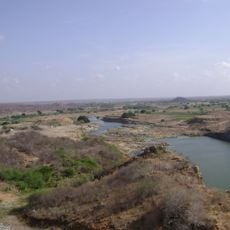
During severe droughts, water levels drop dramatically and reveal submerged structures from the old town that now lies beneath the reservoir. These rare moments allow visitors to glimpse remnants of what was relocated decades earlier.
The community of curious travelers
AroundUs brings together thousands of curated places, local tips, and hidden gems, enriched daily by 92,841 contributors worldwide.